How to Improve Patient Compliance with Home Exercise Programs: A Complete Guide for Physiotherapists
Introduction
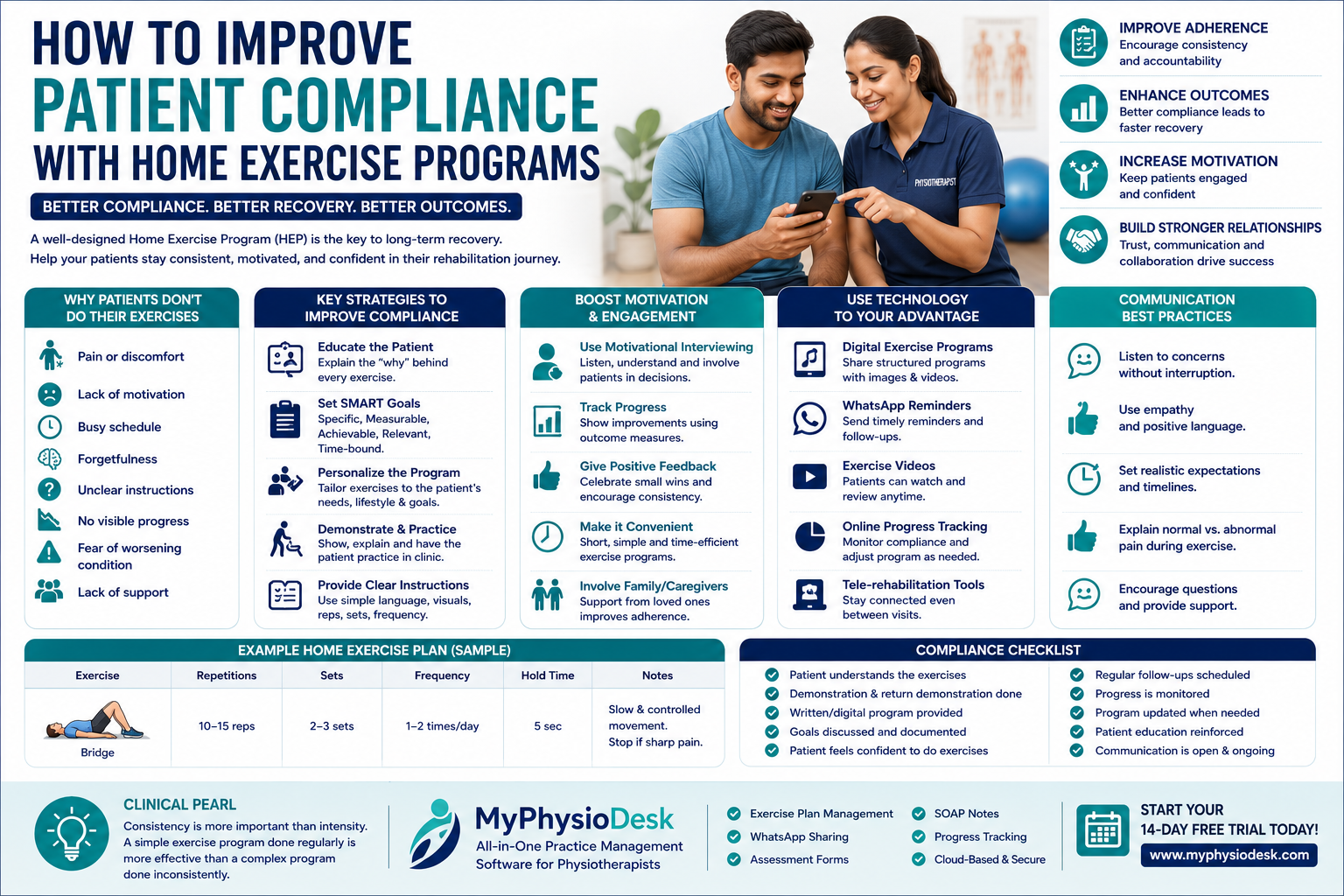
A well-designed treatment plan does not end when the patient leaves the clinic. In physiotherapy, long-term recovery largely depends on what patients do between treatment sessions. Home Exercise Programs (HEPs) are a fundamental part of rehabilitation, helping patients maintain progress, improve strength and mobility, reduce pain, and prevent recurrence of injury.
However, one of the greatest challenges faced by physiotherapists worldwide is poor patient compliance. Research consistently shows that many patients either perform their exercises incorrectly, skip sessions, or stop exercising altogether within the first few weeks of treatment.
Poor adherence delays recovery, increases healthcare costs, reduces patient satisfaction, and often leads to chronic symptoms that could have been prevented through consistent rehabilitation.
This comprehensive guide explores the common reasons patients fail to follow their home exercise programs and provides practical, evidence-informed strategies that physiotherapists can use to improve compliance, increase motivation, and achieve better clinical outcomes.
What is Patient Compliance?
Patient compliance refers to the extent to which a patient follows the rehabilitation recommendations provided by their healthcare professional. In physiotherapy, compliance includes performing prescribed exercises with the correct technique, frequency, intensity, and duration.
Many modern rehabilitation guidelines now prefer the term "adherence" because it emphasizes collaboration between the physiotherapist and the patient rather than simply expecting patients to follow instructions.
Successful rehabilitation depends on active participation, shared decision-making, and consistent communication throughout the treatment journey.
Why Home Exercise Programs Matter
A patient's progress depends on far more than the exercises performed during clinic visits. Most musculoskeletal and neurological conditions require repeated movement practice over weeks or months to achieve lasting improvements.
Home Exercise Programs help patients continue rehabilitation outside the clinic while reinforcing skills learned during supervised sessions.
Benefits include:
- Faster functional recovery
- Improved muscle strength
- Better flexibility
- Enhanced joint mobility
- Reduced pain
- Improved balance and coordination
- Greater confidence during daily activities
- Reduced recurrence of injury
- Lower treatment costs
- Improved long-term health outcomes
The Impact of Poor Compliance
Failure to perform prescribed home exercises can significantly reduce treatment effectiveness.
Common consequences include:
- Delayed recovery
- Persistent pain
- Reduced functional improvement
- Increased risk of re-injury
- Longer rehabilitation duration
- Higher healthcare costs
- Reduced patient confidence
- Lower treatment satisfaction
For physiotherapists, poor compliance can also make it difficult to accurately evaluate whether the treatment plan itself is ineffective or whether exercises simply are not being performed consistently.
Why Patients Stop Performing Home Exercises
Most patients do not intentionally ignore professional advice. Instead, multiple physical, psychological, environmental, and social factors influence adherence.
Common reasons include:
- Pain during exercises
- Lack of motivation
- Busy daily schedules
- Forgetting to exercise
- Poor understanding of instructions
- Fear of worsening the condition
- Slow recovery
- Exercises perceived as boring
- Low confidence
- Lack of family support
- No visible progress
- Unrealistic expectations
Understanding these barriers allows physiotherapists to tailor interventions that improve long-term adherence.
Common Barriers to Home Exercise Compliance
1. Physical Barriers
- Pain
- Fatigue
- Limited mobility
- Poor balance
- Medical comorbidities
2. Psychological Barriers
- Anxiety
- Depression
- Fear of movement (Kinesiophobia)
- Low self-confidence
- Poor motivation
3. Lifestyle Barriers
- Busy work schedules
- Family responsibilities
- Travel
- Lack of routine
- Poor time management
4. Environmental Barriers
- Limited exercise space
- No exercise equipment
- Unsafe surroundings
- Lack of caregiver support
The Importance of Patient Education
Education is one of the strongest predictors of long-term exercise adherence. Patients who understand their condition are generally more motivated to participate actively in rehabilitation.
Rather than simply demonstrating exercises, explain why each exercise is important and how it contributes to recovery.
Patients should understand:
- Their diagnosis
- The cause of their symptoms
- The purpose of each exercise
- Expected recovery timeline
- Normal versus abnormal pain
- Importance of consistency
- Warning signs requiring medical advice
Educated patients are more likely to become active partners in their own recovery rather than passive recipients of treatment.
Build Trust During the Initial Assessment
Patient compliance begins during the first consultation. Trust between the physiotherapist and patient significantly influences whether rehabilitation recommendations will be followed.
Build rapport by:
- Listening without interruption
- Acknowledging patient concerns
- Using simple language
- Avoiding unnecessary medical jargon
- Answering questions honestly
- Encouraging shared decision-making
- Setting realistic expectations
Patients are more likely to follow advice from clinicians who demonstrate empathy, professionalism, and genuine interest in their recovery.
Set SMART Rehabilitation Goals
Patients remain motivated when rehabilitation goals are clear, measurable, and achievable.
Use the SMART framework:
- Specific
- Measurable
- Achievable
- Relevant
- Time-Bound
Examples:
- Walk independently for 20 minutes within four weeks.
- Reduce pain from 7/10 to 3/10 in six weeks.
- Perform stair climbing without assistance within one month.
Celebrating small milestones improves patient confidence and encourages continued participation.
Create Personalized Exercise Programs
A "one-size-fits-all" approach rarely produces optimal adherence. Home Exercise Programs should be tailored to each patient's diagnosis, physical ability, lifestyle, occupation, available equipment, and personal goals.
Consider:
- Patient age
- Fitness level
- Pain severity
- Home environment
- Available time
- Work demands
- Sports participation
- Personal interests
Simple, practical exercises that fit naturally into a patient's daily routine are far more likely to be completed consistently than lengthy or overly complex exercise programs.
Clinical Pearl
Patients rarely stop exercising because they are unwilling to recover. More often, they stop because the program feels confusing, inconvenient, painful, or disconnected from their personal goals. A successful Home Exercise Program should be simple to understand, realistic to perform, and clearly linked to meaningful improvements in the patient's daily life.
Motivational Interviewing: Encouraging Lasting Behavior Change
One of the most effective ways to improve home exercise adherence is through motivational interviewing (MI). Rather than telling patients what they should do, motivational interviewing helps patients identify their own reasons for recovery and encourages active participation in rehabilitation.
Patients are far more likely to follow a rehabilitation program when they feel involved in the decision-making process.
Useful questions include:
- What activities would you most like to return to?
- What concerns do you have about your recovery?
- What challenges might prevent you from exercising at home?
- How confident do you feel about completing these exercises?
- What would make this program easier for you?
Listening carefully and acknowledging patient concerns builds trust while increasing motivation to continue rehabilitation.
Demonstrate Every Exercise Correctly
Many patients discontinue exercises because they are unsure whether they are performing them correctly. Incorrect technique may reduce treatment effectiveness or even increase pain.
During every session:
- Demonstrate each exercise slowly.
- Explain the purpose of the exercise.
- Highlight common mistakes.
- Explain breathing techniques.
- Describe the expected movement.
- Discuss how many repetitions and sets to perform.
Always ask the patient to perform each exercise before leaving the clinic. Correct technique immediately and answer any questions.
Provide Simple and Clear Exercise Instructions
Patients often forget verbal instructions after returning home. Written or digital exercise plans improve understanding and increase confidence.
Each exercise should include:
- Exercise Name
- Starting Position
- Movement Description
- Number of Repetitions
- Number of Sets
- Frequency per Day
- Rest Period
- Safety Precautions
Avoid complicated medical terminology. Use simple language that patients can easily understand.
Written vs Digital Home Exercise Programs
Traditional paper handouts remain useful, but digital exercise programs offer several advantages for both physiotherapists and patients.
| Paper Exercise Sheet | Digital Exercise Program |
|---|---|
| Can be misplaced | Accessible anytime on mobile devices |
| Static images only | Can include exercise videos and illustrations |
| Difficult to update | Easy to modify instantly |
| No progress tracking | Progress can be monitored over time |
| No reminders | Can be shared with digital reminders |
Digital exercise programs improve accessibility and make it easier for patients to follow their rehabilitation plans consistently.
Schedule Regular Follow-Up
Regular follow-up appointments reinforce accountability and allow physiotherapists to address problems before patients lose motivation.
During follow-up visits:
- Review exercise technique.
- Assess progress.
- Modify exercises when appropriate.
- Discuss challenges.
- Celebrate improvements.
- Answer patient questions.
Patients who know their progress will be reviewed are generally more likely to remain committed to their exercise program.
Track Progress Visually
Visible improvement is one of the strongest motivators for continued exercise.
Track measurable outcomes such as:
- Pain Score (VAS/NPRS)
- Range of Motion
- Walking Distance
- Muscle Strength
- Balance Tests
- Functional Independence
- Outcome Measure Scores
Showing patients objective improvements helps reinforce the value of consistent home exercise.
Teach Patients How to Manage Pain During Exercise
Many patients stop exercising because they believe any discomfort indicates further injury. Physiotherapists should educate patients about the difference between acceptable exercise-related discomfort and warning signs that require medical review.
Explain:
- Expected muscle soreness.
- Normal stretching sensations.
- Acceptable pain levels.
- When to reduce intensity.
- When to stop exercising.
- When to contact the clinic.
Providing clear guidance reduces fear and improves confidence.
Use Behavioral Change Techniques
Behavioral strategies help patients incorporate exercises into their daily routine.
Examples include:
- Habit stacking (perform exercises after brushing teeth).
- Exercise calendars.
- Daily reminders.
- Progress charts.
- Reward systems.
- Goal tracking.
- Self-monitoring.
Small, consistent habits are generally more successful than large, demanding exercise programs.
Encourage Family and Caregiver Involvement
Support from family members can significantly improve exercise adherence, particularly for elderly patients and individuals with neurological conditions.
Caregivers can help by:
- Providing encouragement.
- Assisting with exercise setup.
- Ensuring safety.
- Monitoring technique.
- Helping maintain routine.
Family involvement often improves confidence while reducing anxiety about exercising independently.
Communication Mistakes That Reduce Compliance
Even experienced physiotherapists may unintentionally reduce patient adherence through poor communication.
Avoid:
- Giving too many exercises at once.
- Using complex medical terminology.
- Providing unrealistic expectations.
- Ignoring patient concerns.
- Failing to demonstrate exercises.
- Not confirming patient understanding.
- Criticizing poor compliance instead of identifying barriers.
Positive, supportive communication encourages patients to remain engaged in rehabilitation even when progress is slower than expected.
Clinical Pearl
Patients are more likely to complete three exercises consistently than ten exercises inconsistently. Keep home exercise programs simple, practical, and directly related to the patient's functional goals. Review and progress the program regularly rather than overwhelming patients with unnecessary complexity.
Technology Can Improve Home Exercise Compliance
Modern technology has transformed the way physiotherapists deliver Home Exercise Programs (HEPs). Digital platforms allow clinicians to prescribe exercises, share educational resources, monitor patient progress, and maintain communication between appointments.
Patients are more likely to remain engaged when exercise instructions are easily accessible on their smartphones and can be reviewed whenever needed.
Technology can support rehabilitation through:
- Digital exercise programs
- Exercise images and videos
- Mobile-friendly exercise instructions
- Progress tracking
- Appointment reminders
- Patient education resources
- Secure communication
Send Timely Exercise Reminders
One of the most common reasons patients miss their home exercises is simply forgetting. Gentle reminders encourage patients to stay consistent without feeling pressured.
Effective reminders include:
- Daily exercise reminders
- Appointment reminders
- Weekly motivation messages
- Exercise progress follow-ups
- Reassessment reminders
The goal is to encourage consistency rather than overwhelm patients with excessive notifications.
Use Exercise Images and Videos
Patients often struggle to remember the correct exercise technique after leaving the clinic. Visual demonstrations improve confidence and reduce the likelihood of performing exercises incorrectly.
Exercise resources should include:
- Clear exercise photographs
- Step-by-step movement instructions
- Short demonstration videos
- Common mistakes to avoid
- Safety precautions
- Recommended repetitions and sets
Visual learning improves understanding and allows patients to review exercises whenever needed.
Monitor Patient Progress
Regular monitoring helps physiotherapists identify patients who may be struggling before they discontinue their rehabilitation program.
Monitor:
- Pain levels
- Exercise completion
- Range of motion
- Strength improvements
- Balance
- Walking ability
- Functional independence
- Patient confidence
Objective progress tracking also motivates patients by demonstrating measurable improvements over time.
Measure Home Exercise Compliance
Compliance should be evaluated objectively rather than assuming that every patient follows the prescribed program.
Useful assessment methods include:
- Exercise diary
- Patient self-report
- Exercise logbook
- Weekly follow-up discussions
- Functional outcome measures
- Pain score comparison
- Achievement of rehabilitation goals
Understanding why patients miss exercises is more valuable than simply recording whether they completed them.
Use Outcome Measures to Demonstrate Progress
Patients remain motivated when they can see objective improvements in their condition. Standardized outcome measures provide measurable evidence that rehabilitation is working.
Depending on the condition, outcome measures may include:
- Visual Analogue Scale (VAS)
- Numeric Pain Rating Scale (NPRS)
- Oswestry Disability Index (ODI)
- Neck Disability Index (NDI)
- Lower Extremity Functional Scale (LEFS)
- Upper Extremity Functional Index (UEFI)
- Berg Balance Scale (BBS)
- Timed Up and Go (TUG)
- Barthel Index
- Functional Independence Measure (FIM)
Sharing improvements with patients reinforces the importance of continuing their home exercise program.
Clinical Decision Making
Poor compliance should not automatically be interpreted as a lack of motivation. Physiotherapists should identify the underlying barriers before modifying the treatment plan.
Consider:
- Is the program too difficult?
- Is the patient experiencing excessive pain?
- Are the exercises appropriate for the patient's lifestyle?
- Does the patient understand the purpose of each exercise?
- Is additional education required?
- Does the patient require caregiver support?
Clinical reasoning should guide modifications to the exercise program while maintaining realistic rehabilitation goals.
Common Mistakes That Reduce Home Exercise Compliance
- Prescribing too many exercises.
- Using complex instructions.
- Failing to explain the purpose of exercises.
- Ignoring patient preferences.
- Providing unrealistic recovery expectations.
- Not reviewing technique during follow-up.
- Not progressing the exercise program.
- Poor documentation.
- Lack of regular communication.
- Failing to celebrate patient progress.
Home Exercise Compliance Checklist
- ✅ Patient understands their diagnosis.
- ✅ Home Exercise Program is personalized.
- ✅ Exercises demonstrated correctly.
- ✅ Written or digital instructions provided.
- ✅ Patient performed exercises before leaving the clinic.
- ✅ SMART goals established.
- ✅ Follow-up appointments scheduled.
- ✅ Progress monitored regularly.
- ✅ Outcome measures recorded.
- ✅ Program reviewed and progressed appropriately.
Evidence-Informed Clinical Practice
Current rehabilitation literature consistently highlights that patient education, collaborative goal setting, clear communication, and regular follow-up are key factors associated with better adherence to home exercise programs. While exercise prescription is important, successful rehabilitation also depends on addressing behavioral, psychological, and environmental barriers that influence long-term participation.
Physiotherapists who combine individualized exercise programs with ongoing support and objective progress monitoring are more likely to achieve meaningful improvements in patient outcomes.
How MyPhysioDesk Helps Improve Home Exercise Compliance
Managing home exercise programs manually can be time-consuming and inconsistent. MyPhysioDesk provides integrated tools that simplify exercise prescription, improve patient communication, and support better rehabilitation outcomes.
With MyPhysioDesk, physiotherapists can:
- Create personalized digital Exercise Plans.
- Assign exercises with clear images and instructions.
- Share complete exercise plans directly with patients via WhatsApp.
- Maintain structured SOAP Notes alongside prescribed exercises.
- Record Assessment Forms and clinical findings.
- Track patient progress during follow-up visits.
- Store patient records securely in the cloud.
- Access patient information from desktop, tablet, or mobile through the Progressive Web App (PWA).
These features reduce administrative work, improve communication, and help physiotherapists deliver a more consistent rehabilitation experience while encouraging better patient adherence.
Final Thoughts
Home Exercise Programs are one of the most powerful tools available to physiotherapists, but their effectiveness depends on patient participation. Improving compliance requires more than prescribing exercises—it involves patient education, effective communication, individualized treatment planning, regular follow-up, and ongoing motivation.
By understanding the factors that influence adherence and using practical strategies to overcome common barriers, physiotherapists can help patients become active participants in their own recovery. Consistent home exercise performance leads to better functional outcomes, greater patient satisfaction, and long-term improvements in health and quality of life.
Empower Better Recovery with MyPhysioDesk
Whether you manage orthopedic, neurological, sports, pediatric, or geriatric patients, MyPhysioDesk helps you create professional Exercise Plans, maintain structured SOAP Notes, document Assessment Forms, monitor patient progress, and manage your entire physiotherapy practice from one secure cloud-based platform.
Start your 14-Day FREE Trial today.
🌐 https://myphysiodesk.com
Suggested References
- World Physiotherapy. Policy Statement: Physical Activity and Exercise.
- American Physical Therapy Association (APTA). Clinical Practice Resources.
- World Health Organization. Rehabilitation 2030 Initiative.
- Jack K, et al. Barriers to Treatment Adherence in Physiotherapy Outpatient Clinics: A Systematic Review.
- Bassett SF. The Assessment of Patient Adherence to Physiotherapy Rehabilitation.
- World Health Organization. Adherence to Long-Term Therapies: Evidence for Action.
Back to blog