Outcome Measures Used in Neurological Physiotherapy: A Complete Evidence-Based Guide
Introduction
Neurological rehabilitation is one of the most challenging areas of physiotherapy because every patient presents with unique impairments, recovery patterns, and rehabilitation goals. Unlike many musculoskeletal conditions, neurological disorders such as stroke, Parkinson's disease, multiple sclerosis, traumatic brain injury, and spinal cord injury often affect multiple body systems simultaneously.
For this reason, physiotherapists cannot rely solely on clinical observation or subjective judgment when evaluating patient progress. Standardized outcome measures provide objective, reliable, and evidence-based methods to assess impairments, monitor functional recovery, evaluate treatment effectiveness, and support clinical decision-making throughout rehabilitation.
Using validated outcome measures also improves communication among multidisciplinary healthcare teams, facilitates research, enhances patient education, and ensures high-quality documentation in neurological practice.
This comprehensive guide explains the most widely used outcome measures in neurological physiotherapy and how they can be integrated into everyday clinical practice.
What are Outcome Measures?
Outcome measures are standardized assessment tools used to objectively evaluate a patient's impairments, activity limitations, participation restrictions, and overall functional performance.
Unlike informal clinical observation, standardized outcome measures provide measurable scores that can be compared over time, allowing physiotherapists to accurately determine whether a patient's condition is improving, remaining stable, or deteriorating.
Outcome measures are used throughout the rehabilitation process, including:
- Initial Assessment
- Treatment Planning
- Progress Monitoring
- Goal Evaluation
- Discharge Planning
- Long-Term Follow-up
Why Outcome Measures are Important
Evidence-based neurological rehabilitation depends on objective assessment rather than subjective impressions alone. Outcome measures help physiotherapists quantify patient performance and demonstrate meaningful improvements over time.
Benefits include:
- Objective evaluation of patient progress.
- Evidence-based treatment planning.
- Improved clinical decision making.
- Standardized documentation.
- Better communication with physicians and multidisciplinary teams.
- Improved patient motivation through measurable progress.
- Support for clinical audits and research.
- Improved quality of care.
Evidence-Based Practice in Neurological Physiotherapy
Modern neurological rehabilitation emphasizes evidence-based practice (EBP), which integrates the best available research evidence, clinical expertise, and patient values to guide treatment decisions.
Outcome measures are a fundamental component of EBP because they provide reliable data that supports clinical reasoning and allows physiotherapists to evaluate whether interventions are achieving meaningful functional improvements.
International clinical guidelines recommend using standardized outcome measures routinely throughout neurological rehabilitation rather than relying solely on observational assessments.
Selecting the Right Outcome Measure
No single outcome measure can assess every aspect of neurological function. The most appropriate assessment tool depends on the patient's diagnosis, stage of recovery, rehabilitation goals, and functional abilities.
Consider the following factors when selecting an outcome measure:
- Patient Diagnosis
- Severity of Neurological Impairment
- Stage of Recovery
- Clinical Setting
- Time Available
- Equipment Requirements
- Reliability
- Validity
- Responsiveness
- Ease of Administration
Most neurological patients require multiple outcome measures to evaluate different aspects of function such as motor recovery, balance, mobility, cognition, and independence.
Characteristics of an Ideal Outcome Measure
An effective outcome measure should possess strong psychometric properties while remaining practical for routine clinical use.
An ideal assessment tool should be:
- Reliable
- Valid
- Responsive to Change
- Easy to Administer
- Time Efficient
- Clinically Relevant
- Evidence Based
- Easy to Interpret
Selecting high-quality outcome measures improves consistency between therapists and enhances clinical documentation.
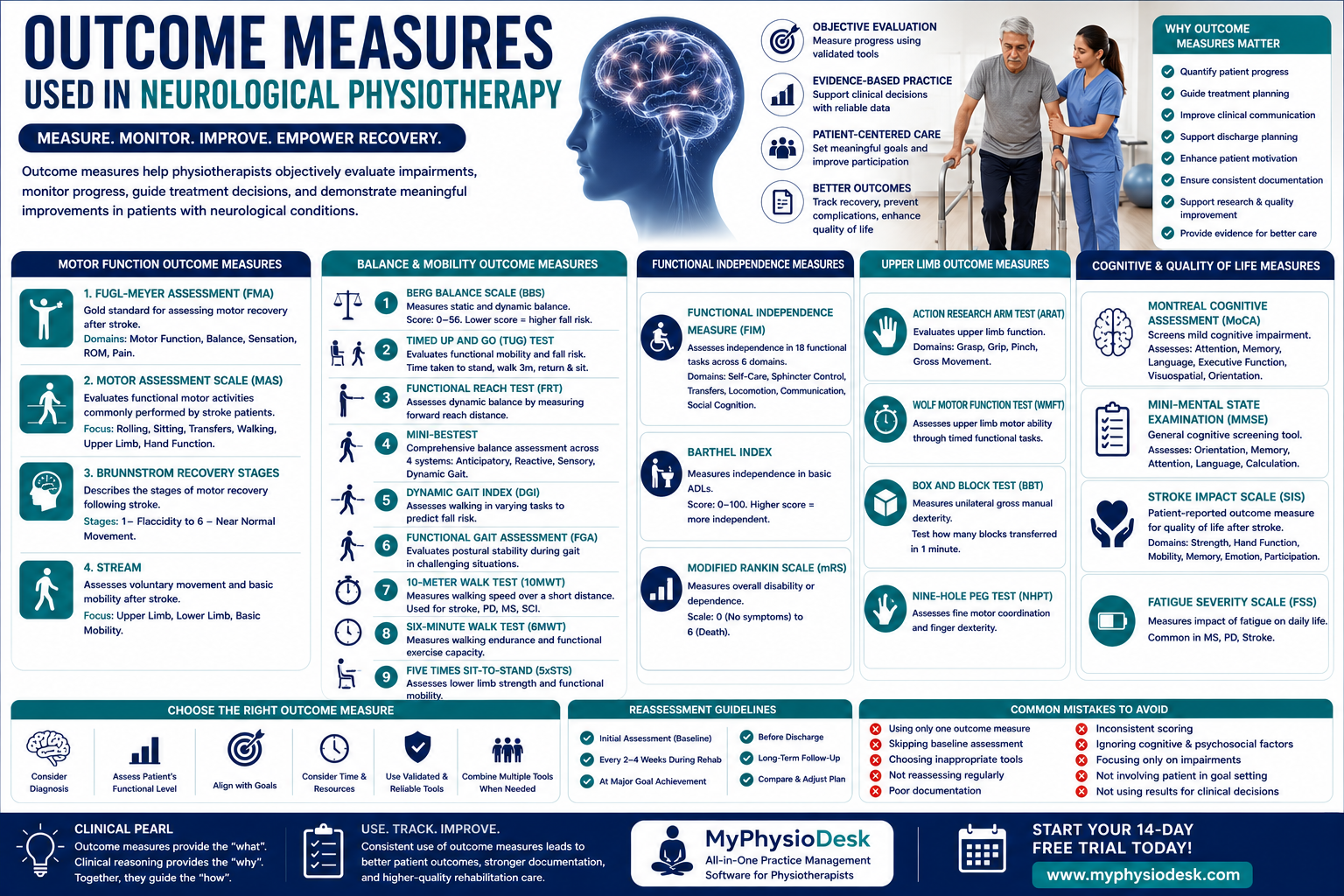
Motor Function Outcome Measures
Motor recovery is one of the primary goals of neurological rehabilitation. The following standardized tools evaluate voluntary movement, motor control, coordination, and functional recovery.
1. Fugl-Meyer Assessment (FMA)
The Fugl-Meyer Assessment is considered one of the gold standards for evaluating motor recovery following stroke. It provides a comprehensive assessment of motor function, balance, sensation, joint range of motion, and joint pain.
Commonly Used For:
- Stroke Rehabilitation
Assessment Domains:
- Upper Limb Motor Function
- Lower Limb Motor Function
- Balance
- Sensation
- Joint Range of Motion
- Joint Pain
Advantages:
- Highly reliable.
- Excellent validity.
- Sensitive to motor recovery.
- Widely accepted in research and clinical practice.
2. Motor Assessment Scale (MAS)
The Motor Assessment Scale evaluates functional motor activities commonly performed by stroke patients. It focuses on practical movement rather than isolated muscle strength.
Assesses:
- Rolling
- Supine to Sitting
- Balanced Sitting
- Sit to Stand
- Walking
- Upper Limb Function
- Hand Movements
- Advanced Hand Activities
Advantages:
- Simple to administer.
- Functional focus.
- Suitable for routine clinical practice.
3. Brunnstrom Recovery Stages
The Brunnstrom Approach classifies motor recovery into sequential stages following stroke. It helps physiotherapists understand motor recovery patterns and plan interventions according to the patient's current stage.
The six recovery stages include:
- Stage 1 – Flaccidity
- Stage 2 – Beginning Spasticity
- Stage 3 – Increased Spasticity
- Stage 4 – Declining Spasticity
- Stage 5 – More Complex Voluntary Movement
- Stage 6 – Near Normal Movement
Understanding recovery stages allows therapists to set realistic rehabilitation goals throughout neurological recovery.
4. Stroke Rehabilitation Assessment of Movement (STREAM)
STREAM evaluates voluntary movement and basic mobility following stroke. It combines impairment-based assessment with functional mobility evaluation.
Evaluates:
- Upper Limb Movement
- Lower Limb Movement
- Basic Mobility
Clinical Advantages:
- Easy scoring system.
- Sensitive to functional recovery.
- Useful during both acute and chronic rehabilitation.
Clinical Pearl
Avoid relying on a single outcome measure when evaluating neurological patients. Motor recovery, balance, mobility, cognition, and functional independence often improve at different rates. Combining multiple standardized assessment tools provides a more complete understanding of the patient's rehabilitation progress and supports better clinical decision making.
Balance and Mobility Outcome Measures
Balance and mobility are among the most important components of neurological rehabilitation. Patients recovering from stroke, Parkinson's disease, multiple sclerosis, traumatic brain injury, and other neurological disorders often experience impaired postural control, reduced walking ability, and an increased risk of falls.
Standardized balance and mobility outcome measures allow physiotherapists to objectively evaluate functional performance, identify fall risk, monitor rehabilitation progress, and modify treatment plans based on measurable improvements.
1. Berg Balance Scale (BBS)
The Berg Balance Scale is one of the most widely used outcome measures for evaluating both static and dynamic balance in neurological rehabilitation.
Commonly Used For:
- Stroke
- Parkinson's Disease
- Multiple Sclerosis
- Elderly Patients
Assessment Includes:
- Sit to Stand
- Standing Unsupported
- Standing with Eyes Closed
- Reaching Forward
- Turning 360°
- Picking Objects from the Floor
- Standing on One Leg
Clinical Advantages:
- Excellent reliability.
- Simple administration.
- Effective fall risk prediction.
- Suitable for repeated reassessment.
2. Timed Up and Go (TUG) Test
The Timed Up and Go Test evaluates functional mobility, walking ability, balance, and fall risk using a quick and practical assessment.
Procedure:
- Stand from a chair.
- Walk 3 meters.
- Turn around.
- Return to the chair.
- Sit down safely.
Measures:
- Functional Mobility
- Balance
- Transfer Ability
- Walking Speed
- Fall Risk
3. Functional Reach Test (FRT)
The Functional Reach Test evaluates dynamic balance by measuring the maximum distance a patient can reach forward without stepping or losing balance.
Assesses:
- Weight Shifting
- Dynamic Stability
- Balance Confidence
- Fall Risk
Reduced reach distance is associated with impaired balance and increased fall risk.
4. Mini-BESTest
The Mini Balance Evaluation Systems Test (Mini-BESTest) provides a comprehensive assessment of balance control across multiple systems.
Assessment Domains:
- Anticipatory Balance
- Reactive Postural Control
- Sensory Orientation
- Dynamic Gait
Commonly Used For:
- Parkinson's Disease
- Stroke
- Vestibular Disorders
- Multiple Sclerosis
5. Dynamic Gait Index (DGI)
The Dynamic Gait Index evaluates a patient's ability to adapt walking to different environmental demands and predicts fall risk during community ambulation.
Tasks Include:
- Walking at Different Speeds
- Head Turns While Walking
- Obstacle Negotiation
- Stair Climbing
- Turning While Walking
6. Functional Gait Assessment (FGA)
The Functional Gait Assessment is an expanded version of the Dynamic Gait Index and is commonly used to assess walking performance in neurological patients.
Evaluates:
- Dynamic Balance
- Walking Stability
- Dual-Task Walking
- Obstacle Negotiation
- Narrow Base Walking
7. 10-Meter Walk Test (10MWT)
The 10-Meter Walk Test measures comfortable and maximum walking speed over a standardized distance.
Clinical Uses:
- Stroke Rehabilitation
- Parkinson's Disease
- Spinal Cord Injury
- Multiple Sclerosis
Measures:
- Walking Speed
- Community Ambulation Ability
- Functional Mobility
8. Six-Minute Walk Test (6MWT)
The Six-Minute Walk Test evaluates walking endurance and functional exercise capacity by measuring the total distance a patient can walk in six minutes.
Measures:
- Walking Endurance
- Functional Capacity
- Cardiorespiratory Fitness
- Community Mobility
9. Five Times Sit-to-Stand Test (5xSTS)
The Five Times Sit-to-Stand Test evaluates lower limb strength, transitional mobility, and functional independence.
Assesses:
- Lower Limb Strength
- Transfer Ability
- Functional Mobility
- Fall Risk
Functional Independence Outcome Measures
While balance and gait tests evaluate mobility, functional independence measures assess how neurological impairments affect the patient's ability to perform everyday activities safely and independently.
10. Functional Independence Measure (FIM)
The Functional Independence Measure (FIM) is considered one of the most comprehensive outcome measures in neurological rehabilitation.
Domains Include:
- Self-Care
- Sphincter Control
- Transfers
- Locomotion
- Communication
- Social Cognition
Clinical Advantages:
- Measures physical and cognitive independence.
- Useful for discharge planning.
- Widely accepted internationally.
11. Barthel Index
The Barthel Index evaluates a patient's independence in performing basic Activities of Daily Living (ADLs).
Assesses:
- Feeding
- Bathing
- Dressing
- Toileting
- Transfers
- Walking
- Stair Climbing
- Bladder Control
- Bowel Control
It is simple, reliable, and widely used in stroke rehabilitation programs worldwide.
12. Modified Rankin Scale (mRS)
The Modified Rankin Scale provides a quick measure of overall disability following neurological injury, particularly stroke.
Score Interpretation:
- 0 – No Symptoms
- 1 – No Significant Disability
- 2 – Slight Disability
- 3 – Moderate Disability
- 4 – Moderately Severe Disability
- 5 – Severe Disability
- 6 – Death
The mRS is commonly used in stroke research, rehabilitation, and long-term outcome evaluation.
Clinical Pearl
Different outcome measures assess different aspects of neurological recovery. For example, the Berg Balance Scale evaluates balance, the 10-Meter Walk Test measures walking speed, the Six-Minute Walk Test assesses endurance, and the Barthel Index measures independence in daily activities. Combining multiple validated tools provides a comprehensive picture of patient progress and supports more informed clinical decision making.
Upper Limb Outcome Measures
Upper limb recovery is one of the greatest rehabilitation challenges following neurological injury. Standardized upper limb outcome measures help physiotherapists objectively evaluate hand function, dexterity, coordination, grasp ability, and upper extremity motor recovery throughout rehabilitation.
13. Action Research Arm Test (ARAT)
The Action Research Arm Test (ARAT) is one of the most widely used outcome measures for assessing upper limb function after stroke.
Commonly Used For:
- Stroke Rehabilitation
- Traumatic Brain Injury
- Multiple Sclerosis
Assessment Domains:
- Grasp
- Grip
- Pinch
- Gross Arm Movement
Clinical Advantages:
- Excellent reliability.
- Sensitive to upper limb recovery.
- Useful for treatment planning.
14. Wolf Motor Function Test (WMFT)
The Wolf Motor Function Test evaluates upper extremity motor ability through timed functional tasks.
Assesses:
- Movement Speed
- Functional Ability
- Motor Control
- Task Performance
It is frequently used during stroke rehabilitation research and clinical practice.
15. Box and Block Test (BBT)
The Box and Block Test measures unilateral gross manual dexterity by counting how many blocks a patient transfers within one minute.
Evaluates:
- Gross Hand Dexterity
- Upper Limb Coordination
- Functional Hand Use
The test is quick, reliable, and easy to administer in clinical settings.
16. Nine-Hole Peg Test (NHPT)
The Nine-Hole Peg Test evaluates fine motor coordination and finger dexterity.
Commonly Used For:
- Stroke
- Multiple Sclerosis
- Parkinson's Disease
- Peripheral Neurological Disorders
Measures:
- Fine Motor Skills
- Hand Coordination
- Finger Dexterity
Cognitive Outcome Measures
Cognitive impairments often influence rehabilitation outcomes, treatment compliance, and functional independence. Physiotherapists should recognize cognitive deficits and collaborate with the multidisciplinary team when appropriate.
17. Montreal Cognitive Assessment (MoCA)
The Montreal Cognitive Assessment (MoCA) is one of the most sensitive screening tools for detecting mild cognitive impairment.
Assesses:
- Attention
- Memory
- Executive Function
- Language
- Orientation
- Visuospatial Skills
MoCA is widely used during stroke and Parkinson's disease rehabilitation.
18. Mini-Mental State Examination (MMSE)
The Mini-Mental State Examination is a widely recognized cognitive screening tool.
Evaluates:
- Orientation
- Memory
- Attention
- Calculation
- Language
- Recall
Although less sensitive than MoCA for mild cognitive impairment, MMSE remains useful for general cognitive screening.
Quality of Life Outcome Measures
Neurological rehabilitation should improve not only physical function but also participation, emotional wellbeing, and overall quality of life.
19. Stroke Impact Scale (SIS)
The Stroke Impact Scale evaluates the patient's perception of recovery across multiple domains.
Domains Include:
- Strength
- Hand Function
- Mobility
- Communication
- Memory
- Emotion
- Participation
It provides valuable insight into how stroke affects everyday life from the patient's perspective.
20. Fatigue Severity Scale (FSS)
Fatigue is a common symptom in neurological disorders and can significantly reduce functional performance.
Commonly Used For:
- Multiple Sclerosis
- Parkinson's Disease
- Stroke
The Fatigue Severity Scale helps quantify fatigue and monitor changes during rehabilitation.
Choosing the Right Outcome Measure
The choice of outcome measure should depend on the patient's diagnosis, functional limitations, stage of recovery, rehabilitation goals, and clinical setting.
For example:
- Motor Recovery: Fugl-Meyer Assessment, STREAM
- Balance: Berg Balance Scale, Mini-BESTest
- Walking: TUG, 10MWT, 6MWT, DGI
- Functional Independence: FIM, Barthel Index
- Upper Limb: ARAT, WMFT, Box & Block Test
- Cognition: MoCA, MMSE
- Quality of Life: Stroke Impact Scale
Using multiple complementary outcome measures provides a more complete picture of neurological recovery.
Recommended Reassessment Schedule
Outcome measures should not be used only during the first evaluation. Regular reassessment helps determine treatment effectiveness and guides progression.
- Initial Assessment
- Every 2–4 Weeks During Active Rehabilitation
- At Major Goal Achievement
- Before Discharge
- Long-Term Follow-Up (when appropriate)
Common Mistakes Physiotherapists Should Avoid
- Using only one outcome measure.
- Selecting assessments inappropriate for the patient's functional level.
- Skipping baseline assessment.
- Failing to reassess progress.
- Ignoring patient-reported outcomes.
- Poor documentation.
- Using outcome measures inconsistently.
- Focusing only on impairments rather than functional performance.
- Not explaining assessment results to patients.
- Ignoring cognitive and psychosocial factors.
Neurological Outcome Measure Checklist
- ✅ Motor Function Assessment
- ✅ Balance Assessment
- ✅ Walking Assessment
- ✅ Functional Independence Assessment
- ✅ Upper Limb Assessment
- ✅ Cognitive Assessment
- ✅ Quality of Life Assessment
- ✅ Goal Setting
- ✅ Documentation
- ✅ Regular Reassessment
Evidence-Informed Clinical Practice
International rehabilitation guidelines support the routine use of standardized outcome measures throughout neurological rehabilitation. Rather than relying solely on clinical observation, physiotherapists should combine validated assessment tools with sound clinical reasoning and patient-centered goal setting to monitor progress and optimize treatment outcomes.
Using outcome measures consistently also improves communication within multidisciplinary teams, facilitates research, supports quality improvement initiatives, and enhances the overall standard of neurological physiotherapy practice.
Final Thoughts
Outcome measures are an essential component of neurological physiotherapy. They transform subjective observations into objective clinical data, enabling physiotherapists to evaluate impairments, monitor recovery, measure treatment effectiveness, and make informed clinical decisions throughout rehabilitation.
No single assessment tool can capture every aspect of neurological recovery. The most effective approach combines multiple standardized outcome measures with comprehensive clinical examination, functional assessment, and patient-centered rehabilitation goals.
MyPhysioDesk simplifies neurological assessment by providing built-in Digital Assessment Forms, structured SOAP Notes, Outcome Measure Recording, Patient Progress Tracking, Goal Management, and secure Cloud-Based Patient Records. Physiotherapists can document assessment scores, compare progress across visits, generate professional clinical records, and spend more time delivering high-quality patient care instead of managing paperwork.
Manage Neurological Rehabilitation More Efficiently with MyPhysioDesk
Whether you're treating stroke, Parkinson's disease, multiple sclerosis, spinal cord injury, traumatic brain injury, or other neurological conditions, MyPhysioDesk helps you organize assessments, record standardized outcome measures, create professional SOAP Notes, monitor patient progress, and maintain complete digital clinical documentation from one secure cloud-based platform.
Start your 14-Day FREE Trial today.
🌐 https://myphysiodesk.com
Suggested References
- World Health Organization (WHO). International Classification of Functioning, Disability and Health (ICF).
- American Physical Therapy Association (APTA). Clinical Practice Guidelines for Neurological Physical Therapy.
- Moore JL, et al. Clinical Practice Guideline to Improve Locomotor Function Following Chronic Stroke.
- Fugl-Meyer AR, et al. The Post-Stroke Hemiplegic Patient: A Method for Evaluation of Physical Performance.
- Berg KO, et al. Measuring Balance in the Elderly: Validation of the Berg Balance Scale.
- Podsiadlo D, Richardson S. The Timed Up and Go Test.
- Duncan PW, et al. Stroke Impact Scale.
- Keith RA, et al. The Functional Independence Measure (FIM).
Back to blog