Balance Assessment Techniques for Neurological Patients: A Complete Clinical Guide for Physiotherapists
Introduction
Balance is one of the most fundamental components of human movement and functional independence. Every day, people rely on their balance system while walking, climbing stairs, reaching for objects, transferring from sitting to standing, and performing countless daily activities. In patients with neurological disorders, impaired balance is one of the leading causes of disability, reduced mobility, falls, fear of movement, and decreased quality of life.
Neurological conditions such as stroke, Parkinson's disease, multiple sclerosis, traumatic brain injury, cerebellar disorders, vestibular dysfunction, spinal cord injury, and peripheral neuropathies often affect the complex interaction between the sensory, motor, and central nervous systems. As a result, patients may experience impaired postural control, abnormal gait patterns, muscle weakness, poor coordination, delayed protective reactions, and increased fall risk.
A comprehensive balance assessment enables physiotherapists to identify impairments, establish baseline functional ability, determine fall risk, monitor patient progress, and develop individualized rehabilitation programs based on objective findings.
This guide provides a structured, evidence-based approach to balance assessment in neurological patients and highlights the essential clinical examination techniques every physiotherapist should master.
Why Balance Assessment is Important
Balance assessment is much more than simply observing whether a patient can stand independently. It helps clinicians understand the patient's ability to maintain stability under different environmental and functional demands.
A proper assessment helps physiotherapists:
- Identify impairments affecting balance and mobility.
- Determine the patient's risk of falls.
- Develop individualized rehabilitation goals.
- Select appropriate treatment interventions.
- Monitor progress objectively during rehabilitation.
- Improve patient safety during mobility training.
- Educate caregivers regarding fall prevention strategies.
Objective balance assessment also improves communication between multidisciplinary healthcare professionals by providing measurable clinical findings.
Understanding the Balance Control System
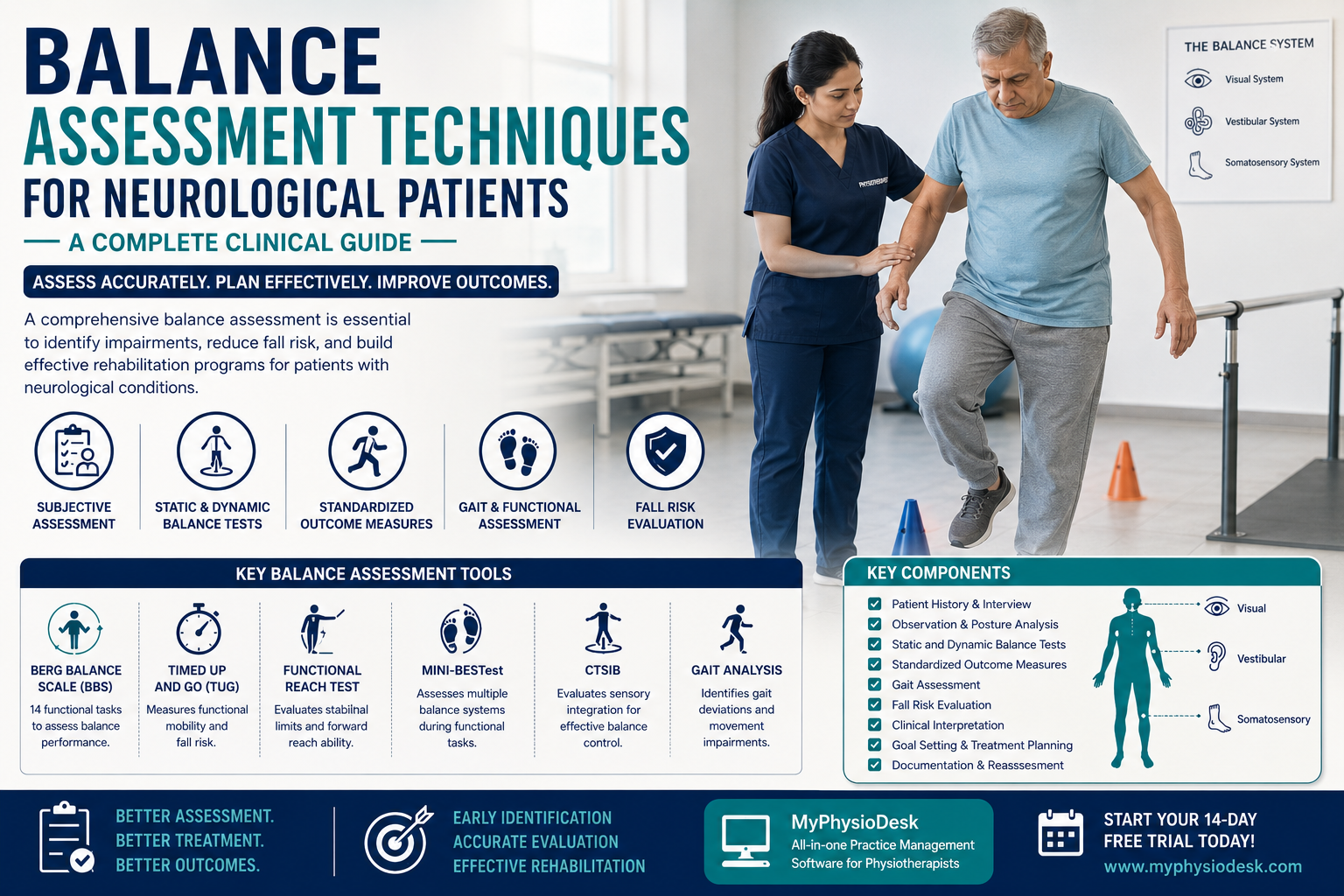
Human balance depends on the integration of three major sensory systems working together under the control of the central nervous system.
1. Visual System
Vision provides information about body position relative to the surrounding environment. Patients often rely heavily on visual feedback when other balance systems are impaired.
2. Vestibular System
The vestibular apparatus located within the inner ear detects head movement, acceleration, and changes in body position. Dysfunction may lead to dizziness, vertigo, poor equilibrium, and instability.
3. Somatosensory System
Proprioceptors located in muscles, tendons, joints, and skin continuously provide information regarding body position, joint movement, and weight distribution.
The brain integrates information from these three systems and produces appropriate motor responses to maintain postural stability.
Damage to any component of this system may result in impaired balance and increased fall risk.
Common Neurological Conditions Affecting Balance
Several neurological disorders commonly present with balance impairment. Understanding the underlying pathology helps physiotherapists perform targeted assessments.
- Stroke
- Parkinson's Disease
- Multiple Sclerosis
- Cerebellar Ataxia
- Traumatic Brain Injury
- Vestibular Disorders
- Peripheral Neuropathy
- Spinal Cord Injury
- Guillain-Barré Syndrome
- Brain Tumors
Each condition affects balance through different mechanisms including muscle weakness, abnormal muscle tone, sensory deficits, impaired coordination, delayed postural reactions, or vestibular dysfunction.
Step 1: Subjective Assessment
A detailed patient interview provides valuable information before beginning the physical examination. Understanding the patient's symptoms, limitations, and concerns guides the selection of appropriate balance assessment techniques.
Patient History
Collect information regarding:
- Primary neurological diagnosis
- Date of onset
- Current medical treatment
- Previous rehabilitation
- Assistive devices used
- History of falls
- Current medications
- Comorbidities
- Previous surgeries
- Living environment
Important Questions to Ask
- When did your balance problems begin?
- Have you experienced any falls recently?
- How often do you lose your balance?
- Do you experience dizziness or vertigo?
- Do you require assistance while walking?
- Do you use a walking stick, walker, or wheelchair?
- Are you afraid of falling?
- Which daily activities are most difficult?
- Do you avoid certain activities because of poor balance?
- Do your symptoms worsen in darkness or on uneven surfaces?
These questions provide important insight into functional limitations and perceived disability.
Step 2: Observation
Observation begins the moment the patient enters the clinic. Many important clinical findings can be identified before formal testing begins.
Observe the Patient During:
- Walking into the treatment room
- Sitting posture
- Standing posture
- Turning
- Transfers
- Getting onto the examination couch
Observe for:
- Head position
- Trunk alignment
- Weight distribution
- Base of support
- Protective movements
- Tremors
- Involuntary movements
- Ataxia
- Muscle wasting
- Assistive device usage
Simple observation often reveals valuable information regarding postural control, movement strategies, and compensatory mechanisms.
Step 3: Cognitive Assessment
Cognitive function significantly influences balance, safety awareness, and rehabilitation outcomes.
Evaluate:
- Level of consciousness
- Orientation to person, place, and time
- Attention and concentration
- Memory
- Ability to follow commands
- Problem-solving ability
- Communication skills
- Insight into balance limitations
Patients with impaired cognition may require modified assessment procedures and additional supervision during rehabilitation.
Step 4: Functional Mobility Assessment
Before formal balance testing, assess the patient's ability to perform basic functional movements safely.
Evaluate:
- Rolling in bed
- Supine to sitting
- Sit to stand
- Standing independently
- Transfers
- Walking short distances
- Turning while walking
- Negotiating obstacles
Functional mobility assessment provides valuable baseline information regarding independence and safety before progressing to standardized balance testing.
Key Clinical Tip
Never begin advanced balance tests without first assessing the patient's safety. Patients with severe neurological impairments should always be guarded appropriately, and assistive devices should be available throughout the assessment to minimize the risk of falls.
Step 5: Static Balance Assessment
Static balance assessment evaluates the patient's ability to maintain stability while remaining stationary. It provides valuable information regarding postural control, weight distribution, sensory integration, and the patient's ability to maintain equilibrium without movement.
Assess the patient's ability to maintain:
- Sitting Balance
- Standing Balance
- Narrow Base Standing
- Tandem Standing
- Single Leg Standing (when appropriate)
Observe for:
- Postural sway
- Weight shifting ability
- Need for upper limb support
- Compensatory movements
- Loss of balance
- Fear of falling
Step 6: Dynamic Balance Assessment
Dynamic balance evaluates the patient's ability to maintain stability while moving. Since most daily activities require movement, dynamic balance testing is essential for neurological rehabilitation.
Assess during:
- Walking
- Turning
- Reaching Forward
- Reaching Sideways
- Bending
- Stepping Over Obstacles
- Changing Direction
- Dual-task Activities
Observe for:
- Instability
- Freezing episodes
- Loss of balance
- Delayed protective reactions
- Foot placement accuracy
Step 7: Berg Balance Scale (BBS)
The Berg Balance Scale is one of the most widely used clinical outcome measures for neurological patients. It evaluates both static and dynamic balance through 14 functional tasks.
Common tasks include:
- Sit to Stand
- Standing Unsupported
- Sitting Unsupported
- Standing with Eyes Closed
- Standing with Feet Together
- Reaching Forward
- Picking Object from Floor
- Turning 360°
- Standing on One Leg
Scoring:
- 0–20 = High Fall Risk
- 21–40 = Moderate Fall Risk
- 41–56 = Low Fall Risk
The Berg Balance Scale is highly reliable for patients with stroke, Parkinson's disease, multiple sclerosis, and elderly individuals.
Step 8: Timed Up and Go (TUG) Test
The Timed Up and Go Test is a simple, quick, and reliable assessment of functional mobility and fall risk.
The patient is instructed to:
- Stand from a chair.
- Walk 3 meters.
- Turn around.
- Walk back.
- Sit down safely.
Interpretation:
- Less than 10 seconds – Normal Mobility
- 10–20 seconds – Independent Mobility
- More than 20 seconds – Mobility Impairment
- More than 30 seconds – High Fall Risk
Step 9: Functional Reach Test (FRT)
The Functional Reach Test evaluates the patient's ability to maintain balance while reaching forward without stepping.
The patient stands comfortably and reaches forward as far as possible without losing balance.
Observe:
- Maximum reach distance
- Weight shifting ability
- Compensatory trunk movements
- Fear of falling
Reduced reach distance is associated with increased fall risk.
Step 10: Romberg Test
The Romberg Test assesses proprioception and sensory integration.
Procedure:
- Stand with feet together.
- Eyes open.
- Eyes closed.
Observe:
- Body sway
- Instability
- Need for assistance
- Loss of balance
A positive Romberg Test may indicate proprioceptive dysfunction or sensory ataxia.
Step 11: Modified Clinical Test of Sensory Interaction on Balance (CTSIB)
CTSIB evaluates how well the patient uses visual, vestibular, and somatosensory information to maintain balance.
Four testing conditions include:
- Eyes Open – Firm Surface
- Eyes Closed – Firm Surface
- Eyes Open – Foam Surface
- Eyes Closed – Foam Surface
This assessment helps identify which sensory system is primarily responsible for balance impairment.
Step 12: Mini-BESTest
The Mini Balance Evaluation Systems Test (Mini-BESTest) is a comprehensive assessment that evaluates multiple components of balance.
It measures:
- Anticipatory Balance
- Reactive Postural Control
- Sensory Orientation
- Dynamic Gait
It is particularly useful for patients with Parkinson's disease and other neurological disorders.
Step 13: Gait Assessment
Balance and gait are closely related. Every neurological balance assessment should include gait analysis.
Observe:
- Walking Speed
- Cadence
- Stride Length
- Step Width
- Heel Strike
- Toe Clearance
- Arm Swing
- Turning Ability
- Freezing Episodes
- Use of Assistive Devices
Abnormal gait patterns often indicate impaired balance and increased fall risk.
Step 14: Fall Risk Assessment
Falls are one of the leading causes of injury among neurological patients. Every assessment should include evaluation of fall risk.
Risk factors include:
- Previous Falls
- Poor Balance
- Muscle Weakness
- Visual Impairment
- Dizziness
- Medications
- Cognitive Impairment
- Environmental Hazards
Patients identified as high risk should receive immediate fall prevention education and individualized rehabilitation.
Clinical Pearl
No single balance test is sufficient. Combine subjective assessment, functional observation, standardized outcome measures, gait analysis, and clinical reasoning to obtain a complete picture of the patient's balance impairments and rehabilitation needs.
Step 15: Clinical Interpretation of Assessment Findings
After completing the subjective and objective assessment, physiotherapists should analyze the collected information to determine the primary impairments affecting the patient's balance and functional mobility. Clinical interpretation should not rely on a single test but instead integrate findings from patient history, observation, neurological examination, gait analysis, balance outcome measures, and functional performance.
Identify the primary causes of balance impairment such as:
- Muscle weakness
- Abnormal muscle tone (Spasticity or Rigidity)
- Poor postural control
- Sensory impairment
- Vestibular dysfunction
- Poor motor planning
- Coordination deficits
- Reduced proprioception
- Fear of falling
- Cognitive impairment
A comprehensive clinical interpretation allows physiotherapists to develop individualized rehabilitation strategies rather than simply treating symptoms.
Step 16: Establish Rehabilitation Goals
Following assessment, develop realistic and measurable rehabilitation goals using the SMART principle.
Short-Term Goals
- Maintain unsupported sitting for 10 minutes.
- Stand independently for 2 minutes.
- Improve Berg Balance Scale score by 5 points.
- Walk 20 meters safely using a walker.
- Reduce fear of falling during transfers.
Long-Term Goals
- Independent community ambulation.
- Perform Activities of Daily Living independently.
- Reduce fall risk.
- Improve balance confidence.
- Return to work or recreational activities.
Step 17: Develop an Individualized Treatment Plan
Treatment should always address the impairments identified during assessment and should be modified according to the patient's progress.
The rehabilitation program may include:
- Static Balance Training
- Dynamic Balance Exercises
- Weight Shifting Activities
- Gait Training
- Strengthening Exercises
- Core Stability Training
- Functional Task Practice
- Coordination Exercises
- Vestibular Rehabilitation
- Dual-Task Training
- Endurance Training
- Home Exercise Program
Treatment intensity and progression should always consider patient safety and fatigue levels.
Document Every Assessment Professionally
Accurate documentation is an essential component of neurological rehabilitation. Every assessment should include subjective findings, objective examination, outcome measure scores, clinical impression, rehabilitation goals, and treatment planning.
Document:
- Subjective Assessment
- Objective Findings
- Balance Test Scores
- Gait Analysis
- Fall Risk Level
- Clinical Impression
- Treatment Goals
- Treatment Plan
- Home Exercise Program
- Next Review Date
Reassessment During Rehabilitation
Neurological rehabilitation requires continuous reassessment to monitor recovery and determine whether treatment goals are being achieved.
Reassess regularly:
- Berg Balance Scale
- Timed Up and Go
- Functional Reach Test
- Mini-BESTest
- Walking Speed
- Balance Confidence
- Fall Risk
- Functional Independence
Comparing previous assessment results allows physiotherapists to objectively measure rehabilitation progress and modify interventions when necessary.
Common Mistakes Physiotherapists Should Avoid
- Skipping subjective assessment.
- Ignoring patient-reported balance difficulties.
- Using only one balance outcome measure.
- Failing to assess gait.
- Not screening for fall risk.
- Ignoring cognitive impairment.
- Poor documentation.
- Not reassessing patient progress.
- Using inappropriate outcome measures.
- Failing to educate patients and caregivers.
Neurological Balance Assessment Checklist
- ✅ Medical History
- ✅ Patient Interview
- ✅ Cognitive Assessment
- ✅ Observation
- ✅ Functional Mobility Assessment
- ✅ Static Balance Assessment
- ✅ Dynamic Balance Assessment
- ✅ Berg Balance Scale
- ✅ Timed Up and Go Test
- ✅ Functional Reach Test
- ✅ Romberg Test
- ✅ CTSIB Assessment
- ✅ Mini-BESTest
- ✅ Gait Analysis
- ✅ Fall Risk Assessment
- ✅ Clinical Interpretation
- ✅ SMART Goal Setting
- ✅ Treatment Planning
- ✅ Documentation
- ✅ Reassessment Plan
Evidence-Based Clinical Practice
Research consistently demonstrates that standardized balance assessment tools improve clinical decision-making, treatment planning, and rehabilitation outcomes. Physiotherapists should combine validated outcome measures with sound clinical reasoning rather than relying solely on observation.
Using evidence-based assessment techniques also improves communication among multidisciplinary healthcare professionals and enhances continuity of patient care.
Final Thoughts
Balance assessment is one of the most important clinical skills in neurological physiotherapy. A structured evaluation enables physiotherapists to identify impairments, determine fall risk, monitor functional recovery, and develop individualized rehabilitation programs that maximize patient independence and quality of life.
Comprehensive documentation is equally important. Maintaining standardized digital assessment records ensures consistency, improves clinical decision-making, and allows therapists to monitor patient progress throughout the rehabilitation journey.
MyPhysioDesk simplifies neurological rehabilitation by providing built-in Digital Assessment Forms, structured SOAP Notes, Goal Tracking, Patient Progress Monitoring, and secure Cloud-Based Patient Records. These features help physiotherapists document every assessment professionally, compare rehabilitation outcomes over multiple sessions, and spend more time delivering quality patient care instead of managing paperwork.
Manage Your Neurological Rehabilitation Practice More Efficiently
Whether you're treating stroke, Parkinson's disease, multiple sclerosis, vestibular disorders, or other neurological conditions, MyPhysioDesk helps you organize patient assessments, maintain professional SOAP Notes, monitor progress, and improve continuity of care—all from one secure cloud-based platform.
Start your 14-Day FREE Trial today.
🌐 https://myphysiodesk.com
Back to blog