Stroke Rehabilitation: Initial Physiotherapy Assessment – A Complete Clinical Guide
Introduction
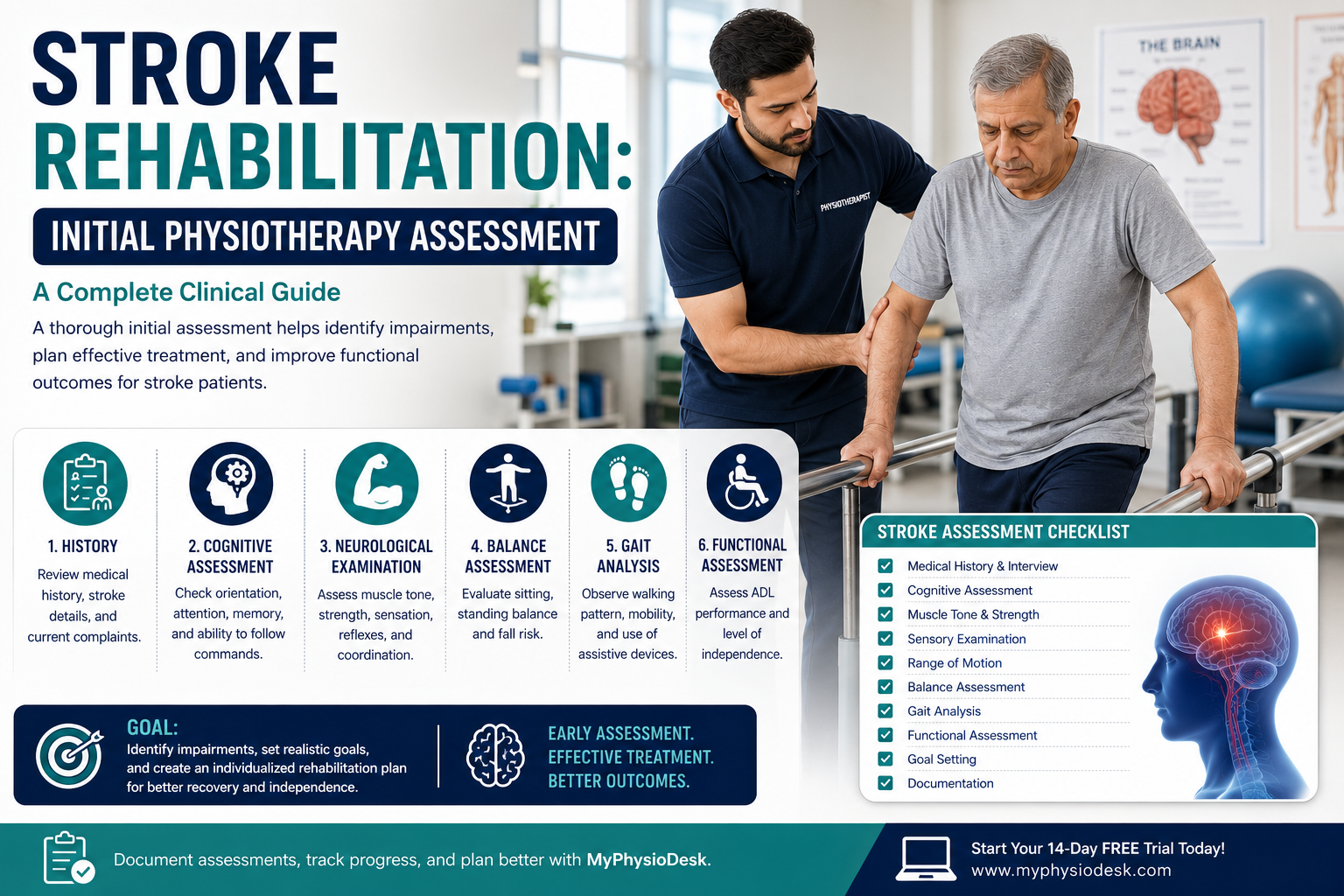
Stroke is one of the leading causes of disability worldwide and often results in motor, sensory, cognitive, and functional impairments. Early physiotherapy assessment plays a vital role in identifying patient limitations, planning individualized rehabilitation programs, and maximizing functional recovery.
A structured assessment allows physiotherapists to evaluate neurological deficits, functional independence, mobility, balance, and muscle performance while identifying potential complications that may interfere with recovery.
This guide outlines the essential components of an initial physiotherapy assessment for patients recovering from stroke.
Step 1: Review Medical History
Begin by reviewing the patient's medical records and history before starting the physical examination.
Collect information regarding:
- Type of stroke (Ischemic or Hemorrhagic)
- Date of stroke onset
- Affected side of the body
- Previous stroke episodes
- Medical history (Hypertension, Diabetes, Heart Disease)
- Current medications
- Previous surgeries
- Current functional status
Step 2: Patient Interview
Communicate with the patient and caregiver to understand functional limitations and rehabilitation goals.
- Chief complaints
- Difficulty in walking
- Difficulty performing daily activities
- Speech or swallowing difficulties
- Pain or shoulder discomfort
- Patient's rehabilitation goals
Step 3: Cognitive Assessment
Assess cognitive function before beginning rehabilitation.
- Level of consciousness
- Orientation (Person, Place, Time)
- Attention span
- Memory
- Communication ability
- Command following
Step 4: Observation
Observe the patient's posture and spontaneous movement.
- Body alignment
- Head and trunk control
- Facial symmetry
- Upper limb positioning
- Lower limb posture
- Presence of neglect
Step 5: Muscle Tone Assessment
Evaluate muscle tone using standardized clinical scales.
- Flaccidity
- Spasticity
- Rigidity
- Modified Ashworth Scale (MAS)
Step 6: Muscle Strength Assessment
Assess voluntary muscle contraction using Manual Muscle Testing (MMT) whenever appropriate.
- Upper limb strength
- Lower limb strength
- Grip strength
- Trunk control
Step 7: Sensory Examination
Evaluate sensory deficits that may affect functional recovery.
- Light touch
- Pain sensation
- Temperature
- Proprioception
- Vibration sense
- Stereognosis
Step 8: Range of Motion (ROM)
Assess active and passive range of motion for all major joints.
- Shoulder
- Elbow
- Wrist
- Hip
- Knee
- Ankle
Identify joint stiffness, contractures, and pain during movement.
Step 9: Balance Assessment
Balance evaluation is essential to determine fall risk and mobility limitations.
- Sitting balance
- Standing balance
- Static balance
- Dynamic balance
- Weight shifting ability
Useful outcome measures include:
- Berg Balance Scale (BBS)
- Functional Reach Test
- Timed Up and Go (TUG)
Step 10: Gait Assessment
Observe walking pattern carefully.
- Walking speed
- Step length
- Cadence
- Foot clearance
- Use of assistive devices
- Weight bearing
- Symmetry
Step 11: Functional Assessment
Determine the patient's level of independence.
- Bed mobility
- Rolling
- Sit-to-stand transfer
- Transfers
- Walking
- Stair climbing
- Activities of Daily Living (ADLs)
Recommended assessment tools:
- Barthel Index
- Functional Independence Measure (FIM)
- Modified Rankin Scale (mRS)
Step 12: Goal Setting
Develop SMART rehabilitation goals based on assessment findings.
Examples:
- Improve sitting balance within two weeks.
- Walk 20 meters independently using a walker.
- Increase shoulder ROM by 20 degrees.
- Improve independence in daily activities.
Stroke Assessment Checklist
- ✅ Medical History
- ✅ Patient Interview
- ✅ Cognitive Assessment
- ✅ Observation
- ✅ Muscle Tone Assessment
- ✅ Muscle Strength
- ✅ Sensory Examination
- ✅ Range of Motion
- ✅ Balance Assessment
- ✅ Gait Analysis
- ✅ Functional Assessment
- ✅ Rehabilitation Goals
Final Thoughts
A comprehensive initial assessment forms the foundation of successful stroke rehabilitation. By systematically evaluating neurological function, mobility, balance, strength, sensation, and functional independence, physiotherapists can develop individualized treatment plans that maximize recovery and improve quality of life.
To make documentation easier and more consistent, MyPhysioDesk provides built-in Digital Assessment Forms, SOAP Notes, Goal Tracking, and secure Digital Patient Records. These features help physiotherapists document every assessment professionally, monitor rehabilitation progress over time, and focus more on delivering quality patient care.
Start your 14-Day FREE Trial today.
🌐 https://app.myphysiodesk.com
Back to blog