ACL Rehabilitation Protocol Explained: A Complete Guide for Physiotherapists
Introduction
Anterior Cruciate Ligament (ACL) injuries are among the most common and challenging sports-related knee injuries encountered by physiotherapists. They frequently affect athletes participating in football, cricket, basketball, badminton, volleyball, tennis, skiing, gymnastics, and other activities that involve cutting, pivoting, jumping, and rapid changes in direction.
An ACL injury can significantly impact knee stability, athletic performance, and quality of life. Without an appropriate rehabilitation program, patients remain at increased risk of persistent instability, recurrent injury, reduced confidence, and premature osteoarthritis.
Successful rehabilitation requires much more than restoring knee range of motion. Modern ACL rehabilitation focuses on reducing pain and swelling, restoring strength, improving neuromuscular control, correcting movement patterns, enhancing psychological readiness, and safely returning patients to sport while minimizing the risk of reinjury.
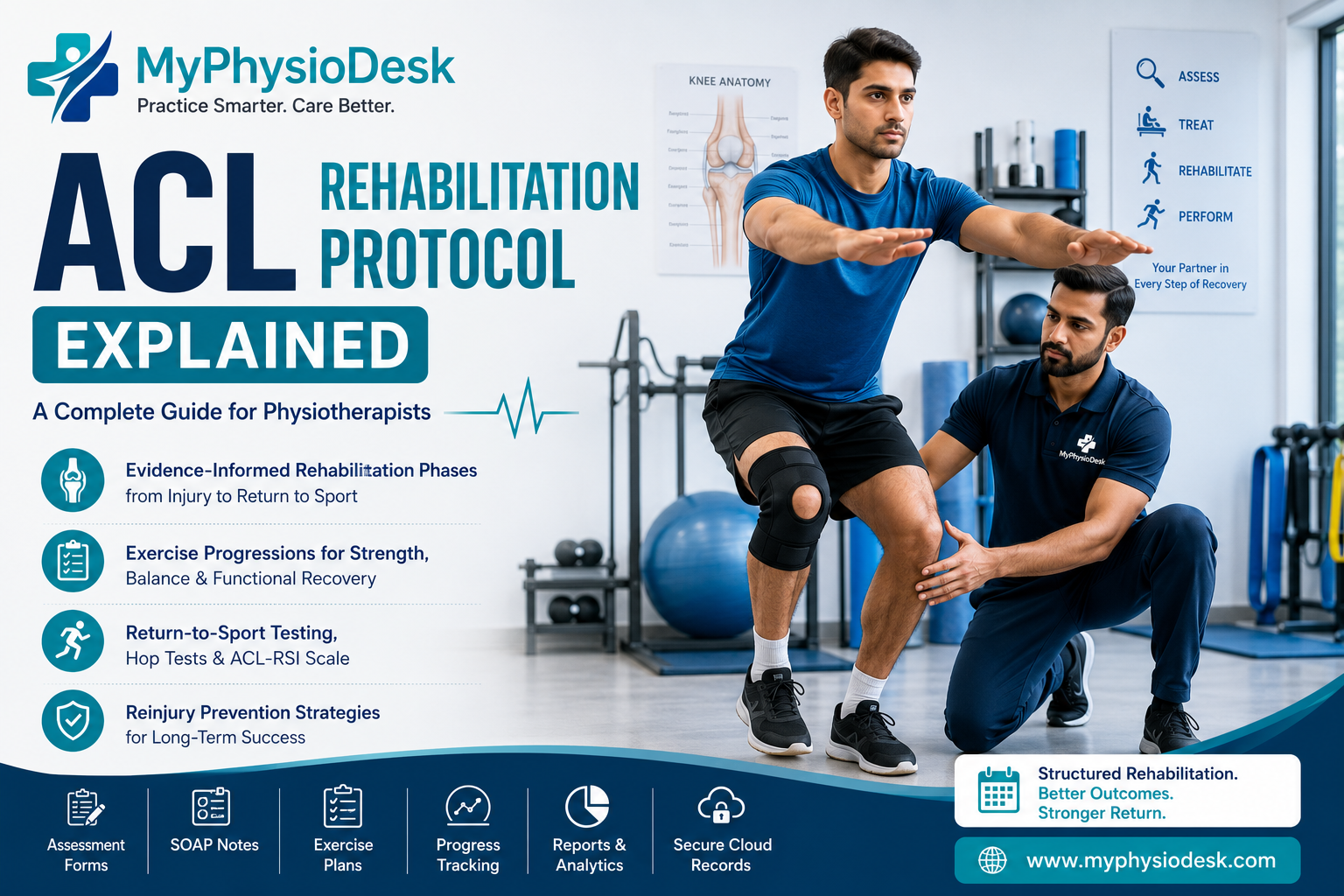
This comprehensive guide explains the complete ACL rehabilitation protocol, including rehabilitation phases, clinical goals, exercise progression, functional recovery, and evidence-informed physiotherapy strategies.
Understanding ACL Anatomy
The Anterior Cruciate Ligament (ACL) is one of the four major stabilizing ligaments of the knee joint. It connects the femur (thigh bone) to the tibia (shin bone) and plays a crucial role in maintaining knee stability during movement.
The ACL primarily functions to:
- Prevent anterior translation of the tibia.
- Control rotational stability.
- Provide proprioceptive feedback.
- Assist dynamic knee stability during sports activities.
- Protect the knee during landing, cutting, and pivoting movements.
Damage to the ACL compromises both mechanical stability and neuromuscular control, making structured rehabilitation essential.
Common Causes of ACL Injury
Approximately 70% of ACL injuries occur without direct contact. Most injuries result from sudden changes in movement that overload the ligament beyond its capacity.
Common injury mechanisms include:
- Sudden deceleration.
- Pivoting on a planted foot.
- Awkward landing after jumping.
- Rapid change of direction.
- Hyperextension of the knee.
- Direct trauma to the knee.
Understanding the injury mechanism helps physiotherapists identify associated injuries and develop individualized rehabilitation strategies.
Sports Commonly Associated with ACL Injuries
- Football (Soccer)
- Basketball
- Badminton
- Volleyball
- Cricket
- Handball
- Rugby
- Tennis
- Skiing
- Gymnastics
Athletes participating in sports requiring frequent cutting, jumping, and pivoting movements are at particularly high risk.
Signs and Symptoms of an ACL Injury
Patients often describe a distinct injury event followed by rapid functional decline.
Common clinical findings include:
- A popping sensation at the time of injury.
- Immediate knee pain.
- Rapid joint swelling (hemarthrosis).
- Difficulty bearing weight.
- Feeling of instability or "giving way."
- Reduced range of motion.
- Difficulty walking.
- Loss of confidence during movement.
Clinical Assessment
A comprehensive assessment helps determine injury severity, identify associated injuries, and establish an appropriate rehabilitation plan.
Subjective Assessment:
- Mechanism of injury.
- Audible pop.
- Immediate swelling.
- Previous knee injuries.
- Sport participation.
- Functional limitations.
- Patient goals.
Objective Assessment:
- Observation.
- Swelling assessment.
- Gait analysis.
- Range of motion.
- Quadriceps activation.
- Hamstring function.
- Patellar mobility.
- Balance assessment.
Special Tests (performed when appropriate):
- Lachman Test
- Anterior Drawer Test
- Pivot Shift Test
Magnetic Resonance Imaging (MRI) is commonly used to confirm the diagnosis and identify associated injuries such as meniscal tears or cartilage damage.
Conservative vs Surgical Management
Not every ACL injury requires reconstruction surgery. Management depends on the patient's activity level, knee stability, associated injuries, occupational demands, and personal goals.
Conservative Management May Be Suitable For:
- Older adults.
- Low-demand individuals.
- Patients with good functional stability.
- Partial ACL injuries.
ACL Reconstruction Is Commonly Recommended For:
- Competitive athletes.
- Patients with recurrent instability.
- Young active individuals.
- Combined ligament injuries.
- Patients planning to return to pivoting sports.
Regardless of treatment choice, physiotherapy remains essential for restoring function and optimizing long-term outcomes.
Principles of ACL Rehabilitation
Modern ACL rehabilitation follows a criterion-based progression rather than relying solely on time since injury or surgery. Patients should advance through each phase only after meeting specific clinical milestones.
The key rehabilitation principles include:
- Protect healing tissues.
- Control pain and swelling.
- Restore full knee extension early.
- Gradually improve knee flexion.
- Restore normal gait.
- Prevent quadriceps inhibition.
- Improve neuromuscular control.
- Progress strengthening safely.
- Enhance proprioception.
- Use functional testing before returning to sport.
Phase 1: Immediate Post-Injury / Early Post-Operative Phase (0–2 Weeks)
The first phase focuses on protecting the knee while minimizing secondary complications such as joint stiffness, muscle inhibition, and excessive swelling.
Primary Goals
- Reduce pain.
- Control swelling.
- Restore full knee extension.
- Achieve approximately 90° of knee flexion (or as guided by the surgeon).
- Activate the quadriceps.
- Protect the graft or healing ligament.
- Promote safe weight bearing as advised.
Precautions During Phase 1
- Avoid excessive twisting movements.
- Do not force painful knee flexion.
- Follow weight-bearing restrictions if prescribed.
- Monitor for signs of infection after surgery.
- Avoid high-impact activities.
- Protect the surgical incision.
Recommended Early Exercises
Exercises should be selected based on surgical protocol, tissue healing, pain levels, and patient tolerance.
- Ankle Pumps
- Quadriceps Sets
- Straight Leg Raises (if no extension lag)
- Heel Slides
- Passive Knee Extension
- Patellar Mobilization
- Hip Abduction Exercises
- Hip Extension Exercises
- Core Activation
- Weight-Shifting Exercises (when appropriate)
Each exercise should be performed with controlled movement, proper technique, and without provoking excessive pain or swelling.
Pain and Swelling Management
Effective management of pain and inflammation during the early rehabilitation phase creates a foundation for successful long-term recovery.
Common strategies include:
- Cryotherapy (ice application).
- Compression.
- Elevation.
- Protected weight bearing.
- Appropriate use of assistive devices.
- Gentle active movement within tolerated limits.
Pain should be monitored regularly, and exercise intensity adjusted if swelling or discomfort significantly increases after rehabilitation sessions.
Clinical Pearl
One of the most important goals during the first two weeks is achieving full knee extension. Delayed restoration of extension can negatively affect gait mechanics, quadriceps activation, and long-term functional outcomes. Progress exercises based on the patient's clinical presentation rather than following a rigid timeline.
Phase 2: Early Rehabilitation Phase (2–6 Weeks)
Once pain and swelling are controlled and the patient demonstrates good quadriceps activation with full knee extension, rehabilitation progresses into the early strengthening phase. The primary objective during this stage is to restore normal movement patterns while protecting healing tissues.
Primary Goals of Phase 2
- Achieve full knee extension.
- Gradually restore full knee flexion.
- Normalize walking pattern.
- Improve quadriceps strength.
- Restore hamstring function.
- Improve weight-bearing confidence.
- Enhance neuromuscular control.
- Begin balance training.
Criteria to Enter Phase 2
- Minimal knee swelling.
- Pain well controlled.
- Full passive knee extension.
- Approximately 90–120° knee flexion (or surgeon's recommendation).
- Good quadriceps activation.
- Independent ambulation with appropriate assistive device if required.
Recommended Exercises
Range of Motion Exercises
- Heel Slides
- Stationary Bicycle (Low Resistance)
- Wall Slides
- Passive Knee Flexion Stretch
Strengthening Exercises
- Mini Squats (0–45°)
- Leg Press (Limited Range)
- Step-Ups
- Bridge Exercise
- Straight Leg Raise Progression
- Hip Strengthening Exercises
- Calf Raises
Neuromuscular Exercises
- Weight Shifting
- Single-Leg Weight Acceptance
- Balance Board Training
- Double-Leg Balance
Gait Training
Restoring a normal walking pattern is one of the major priorities during this phase. Patients often develop compensatory gait patterns due to pain, weakness, or fear of movement.
Focus on:
- Heel strike.
- Controlled knee extension during stance.
- Equal step length.
- Proper weight transfer.
- Normal walking speed.
Assistive devices should only be discontinued when the patient demonstrates safe and symmetrical gait mechanics.
Quadriceps Strengthening
Quadriceps weakness is one of the biggest challenges following ACL injury or reconstruction. Persistent weakness may delay return to sport and increase reinjury risk.
Exercise progression should emphasize proper movement quality before increasing resistance.
Examples include:
- Quadriceps Sets
- Terminal Knee Extension
- Mini Squats
- Wall Squats
- Leg Press
- Sit-to-Stand Exercises
Hamstring Strengthening
The hamstrings act as dynamic stabilizers of the knee by reducing anterior tibial translation. Strengthening should progress gradually while respecting surgical precautions, particularly in patients with hamstring tendon grafts.
Recommended exercises include:
- Hamstring Isometrics
- Bridge Variations
- Swiss Ball Bridges
- Standing Hamstring Curls
Balance and Proprioception Training
ACL injuries impair proprioception because mechanoreceptors within the ligament contribute to joint position sense. Balance training is therefore an essential component of rehabilitation.
Exercises may include:
- Double-Leg Balance
- Single-Leg Standing
- Foam Surface Balance
- Balance Board Training
- Weight Transfer Exercises
- Perturbation Training
Balance exercises should gradually become more challenging as stability improves.
Neuromuscular Control
Neuromuscular deficits often persist long after pain has resolved. Physiotherapists should focus on restoring coordinated movement patterns through repetitive functional training.
Key objectives include:
- Improve joint stability.
- Enhance movement coordination.
- Reduce compensatory patterns.
- Improve dynamic knee control.
- Develop confidence during movement.
Phase 3: Progressive Strengthening Phase (6–12 Weeks)
During this phase, rehabilitation progresses toward advanced strengthening and functional movement training. Patients should begin preparing for higher-level physical activities while maintaining excellent movement quality.
Primary Goals
- Restore full range of motion.
- Increase muscular strength.
- Improve muscular endurance.
- Enhance dynamic balance.
- Develop lower limb power.
- Improve cardiovascular fitness.
- Prepare for sport-specific rehabilitation.
Progressive Strength Training
Strength training should gradually become more functional while respecting tissue healing timelines.
Recommended exercises include:
- Full Squats (As Appropriate)
- Lunges
- Split Squats
- Romanian Deadlifts
- Leg Press Progression
- Single-Leg Squats
- Step-Down Exercises
- Hip Abductor Strengthening
Functional Movement Training
Patients should begin performing movements that simulate everyday activities and athletic demands.
- Sit-to-Stand
- Single-Leg Sit-to-Stand
- Lateral Step-Ups
- Walking Lunges
- Controlled Stair Climbing
- Multi-Directional Reaching
Cardiovascular Conditioning
Maintaining aerobic fitness supports overall recovery and prepares athletes for later return-to-sport phases.
Suitable options include:
- Stationary Cycling
- Swimming (When Appropriate)
- Elliptical Trainer
- Upper Body Ergometer
Criteria to Progress Beyond Phase 3
Progression should be based on objective clinical findings rather than time alone.
Patients should demonstrate:
- Full pain-free knee range of motion.
- Minimal or no swelling.
- Normal walking pattern.
- Good quadriceps and hamstring strength.
- Excellent single-leg balance.
- Proper movement mechanics during squatting and lunging.
- Confidence during functional activities.
Common Rehabilitation Mistakes
Several errors can delay recovery or increase the risk of reinjury.
- Progressing exercises too quickly.
- Ignoring persistent swelling.
- Neglecting quadriceps strengthening.
- Insufficient balance training.
- Poor movement quality during exercises.
- Overemphasizing open-chain exercises early in rehabilitation.
- Ignoring patient confidence and psychological readiness.
- Returning to sport based solely on time since surgery.
Clinical Pearl
The transition from basic rehabilitation to advanced strengthening should be based on functional performance rather than a calendar. Patients who demonstrate excellent movement quality, good neuromuscular control, and symmetrical lower limb strength generally achieve better long-term outcomes than those who simply follow a time-based protocol.
Phase 4: Advanced Rehabilitation and Return-to-Sport Phase (3–6+ Months)
Once the patient demonstrates good muscular strength, full knee range of motion, excellent balance, and pain-free functional movement, rehabilitation progresses to advanced sports-specific training. This phase prepares the athlete for the physical and psychological demands of returning to competitive sport while minimizing the risk of reinjury.
Progression during this stage should always be based on objective functional testing rather than time alone.
Primary Goals of Phase 4
- Restore lower limb strength symmetry.
- Develop explosive power.
- Improve dynamic stability.
- Restore agility and coordination.
- Enhance cardiovascular fitness.
- Correct movement mechanics.
- Build confidence during sports participation.
- Prepare for unrestricted return to sport.
Running Progression
Running should only begin after the patient demonstrates good quadriceps strength, minimal swelling, full range of motion, and proper movement mechanics during functional testing.
A gradual progression may include:
- Brisk Walking
- Walk–Jog Intervals
- Continuous Slow Jogging
- Moderate Running
- Sprint Progression
- Multi-Directional Running
Pain, swelling, or altered movement patterns following running indicate that progression should be slowed until symptoms resolve.
Plyometric Training
Plyometric exercises improve power production, landing mechanics, and neuromuscular control. These exercises should be introduced gradually and only after adequate strength has been achieved.
Examples include:
- Double-Leg Jumping
- Box Jumps
- Jump Squats
- Broad Jumps
- Lateral Hops
- Single-Leg Hops
- Drop Jumps
Focus on soft, controlled landings with proper knee alignment and symmetrical weight distribution.
Agility Training
Agility drills prepare athletes for rapid changes of direction commonly required during sports participation.
Examples include:
- Shuttle Runs
- Zig-Zag Running
- Figure-of-Eight Running
- Ladder Drills
- Cone Drills
- Lateral Shuffles
- Carioca Drills
Movement quality should remain the priority throughout agility progression.
Sport-Specific Training
Before returning to competition, rehabilitation should closely replicate the physical demands of the athlete's sport.
Examples include:
- Football Dribbling and Cutting
- Badminton Lunges
- Basketball Jump Landing
- Cricket Fielding Drills
- Tennis Direction Changes
- Volleyball Jumping Drills
Sport-specific drills improve confidence while exposing the athlete to controlled movement patterns before unrestricted competition.
Return-to-Sport Functional Testing
Objective testing is essential before clearing an athlete for unrestricted sports participation.
Functional assessment should include:
- Single-Leg Squat
- Single-Leg Balance
- Landing Mechanics
- Agility Performance
- Running Technique
- Movement Quality
- Strength Symmetry
Both objective performance and movement quality should be evaluated.
Hop Test Battery
Hop testing is widely used to evaluate lower limb power, symmetry, and readiness for return to sport.
Common hop tests include:
- Single Hop for Distance
- Triple Hop for Distance
- Crossover Hop
- 6-Meter Timed Hop Test
Results are commonly compared with the uninjured limb to identify remaining functional deficits.
Psychological Readiness
Physical recovery alone does not guarantee successful return to sport. Many athletes experience fear of reinjury, reduced confidence, or anxiety despite excellent physical performance.
Physiotherapists should evaluate:
- Fear of Movement
- Confidence
- Motivation
- Sport-Specific Readiness
- Patient Expectations
The ACL Return to Sport after Injury (ACL-RSI) Scale is commonly used to assess psychological readiness before return to competition.
Criteria for Return to Sport
Current rehabilitation guidelines recommend meeting multiple objective criteria before unrestricted sports participation.
Typical criteria include:
- Full pain-free knee range of motion.
- No joint swelling.
- Excellent quadriceps and hamstring strength.
- Successful completion of hop tests.
- Good dynamic balance.
- Excellent movement quality.
- Psychological readiness.
- Medical clearance when appropriate.
Preventing ACL Reinjury
Athletes remain at increased risk of reinjury after returning to sport. Ongoing injury prevention strategies should continue throughout the athletic season.
Recommended prevention strategies include:
- Neuromuscular Training
- Strength Maintenance
- Landing Technique Training
- Agility Drills
- Regular Balance Exercises
- Proper Warm-Up Programs
- Fatigue Management
- Sport-Specific Conditioning
Outcome Measures
Objective outcome measures allow physiotherapists to monitor recovery and make evidence-informed clinical decisions.
Commonly used measures include:
- International Knee Documentation Committee (IKDC)
- Knee Injury and Osteoarthritis Outcome Score (KOOS)
- Lysholm Knee Score
- Tegner Activity Scale
- Visual Analogue Scale (VAS)
- ACL Return to Sport after Injury (ACL-RSI) Scale
- Hop Test Battery
Common Rehabilitation Mistakes
- Progressing too quickly.
- Ignoring persistent swelling.
- Returning to sport without functional testing.
- Neglecting neuromuscular training.
- Poor landing mechanics.
- Focusing only on strength while ignoring movement quality.
- Ignoring psychological readiness.
- Stopping rehabilitation immediately after return to sport.
- Inadequate patient education.
- Poor documentation of progress.
Complete ACL Rehabilitation Checklist
- ✅ Pain Assessment
- ✅ Swelling Assessment
- ✅ Range of Motion
- ✅ Quadriceps Activation
- ✅ Hamstring Strength
- ✅ Balance Assessment
- ✅ Proprioception Training
- ✅ Gait Assessment
- ✅ Functional Movement Assessment
- ✅ Plyometric Progression
- ✅ Agility Training
- ✅ Hop Test Battery
- ✅ Psychological Readiness
- ✅ Return-to-Sport Assessment
- ✅ Injury Prevention Program
Evidence-Informed Clinical Practice
Modern ACL rehabilitation emphasizes criterion-based progression instead of relying solely on time after injury or surgery. Current clinical guidelines support combining objective strength assessment, functional performance testing, movement quality analysis, and psychological readiness before clearing athletes for unrestricted sports participation.
Successful rehabilitation also requires continuous patient education, individualized exercise progression, and regular reassessment to ensure that recovery remains safe, effective, and aligned with the patient's goals.
Final Thoughts
ACL rehabilitation is a structured and progressive process that extends well beyond restoring knee movement. Effective rehabilitation combines pain management, strength development, neuromuscular training, balance improvement, sport-specific conditioning, and psychological support to help patients return safely to their desired activities.
By using objective outcome measures, functional testing, and evidence-informed clinical reasoning, physiotherapists can make confident rehabilitation decisions while reducing the risk of reinjury and improving long-term patient outcomes.
MyPhysioDesk simplifies ACL rehabilitation by providing built-in Digital Assessment Forms, structured SOAP Notes, personalized Exercise Plans, Patient Progress Tracking, Clinical Attachments, and secure Cloud-Based Patient Records. These tools help physiotherapists document each rehabilitation phase, monitor recovery objectively, compare functional progress over time, and deliver consistent, high-quality patient care.
Simplify ACL Rehabilitation with MyPhysioDesk
Whether you're managing recreational athletes or elite sports professionals, MyPhysioDesk helps you create structured rehabilitation plans, record assessment findings, generate professional SOAP Notes, prescribe personalized exercise programs, monitor patient recovery, and maintain complete digital clinical records—all from one secure cloud-based platform.
Start your 14-Day FREE Trial today.
🌐 https://myphysiodesk.com
Suggested References
- American Physical Therapy Association (APTA). Clinical Practice Guidelines for Anterior Cruciate Ligament Management.
- British Journal of Sports Medicine. Consensus on Return to Sport Following ACL Reconstruction.
- van Melick N, et al. Evidence-Based Clinical Practice Update: ACL Rehabilitation.
- Ardern CL, et al. Return to Sport Following ACL Reconstruction.
- Grindem H, et al. Criteria-Based Return-to-Sport Testing After ACL Injury.
- International Olympic Committee (IOC). Consensus Statement on Prevention of Sports Injuries.
Back to blog