Functional Independence Assessment in Stroke Patients: A Complete Guide for Physiotherapists
Introduction
Stroke remains one of the leading causes of long-term disability worldwide and frequently results in impairments affecting movement, sensation, balance, cognition, communication, and activities of daily living. While reducing neurological deficits is an important goal of rehabilitation, the ultimate objective of physiotherapy is to restore the patient's functional independence and improve quality of life.
A patient who regains muscle strength but cannot independently transfer, walk safely, dress, or perform self-care activities has not achieved complete functional recovery. Therefore, assessing functional independence is one of the most important responsibilities of every neurological physiotherapist.
A structured functional independence assessment enables clinicians to determine baseline ability, identify activity limitations, establish realistic rehabilitation goals, measure progress objectively, and develop individualized treatment programs based on each patient's needs.
This comprehensive guide explains the evidence-based approach used by physiotherapists to evaluate functional independence after stroke and highlights the essential assessment techniques that support successful neurological rehabilitation.
What is Functional Independence?
Functional independence refers to a person's ability to perform daily activities safely and effectively without assistance from another individual. Following a stroke, patients may lose independence because of muscle weakness, impaired balance, abnormal muscle tone, sensory deficits, reduced coordination, cognitive impairment, or communication difficulties.
The degree of independence varies widely among patients. Some individuals require complete assistance for basic self-care, whereas others regain independence with only minimal supervision.
Assessing functional independence allows physiotherapists to determine the patient's current abilities while identifying areas requiring rehabilitation.
Why Functional Independence Assessment is Important
Neurological rehabilitation focuses not only on restoring movement but also on enabling patients to participate independently in everyday life. Functional assessment provides objective information regarding how neurological impairments affect daily performance.
A comprehensive assessment helps physiotherapists:
- Determine baseline functional ability.
- Identify activity limitations.
- Evaluate participation restrictions.
- Establish realistic rehabilitation goals.
- Measure treatment effectiveness objectively.
- Predict discharge requirements.
- Educate patients and caregivers.
- Improve interdisciplinary communication.
Objective functional assessments also provide measurable outcomes that support evidence-based clinical decision making throughout rehabilitation.
The International Classification of Functioning (ICF) Framework
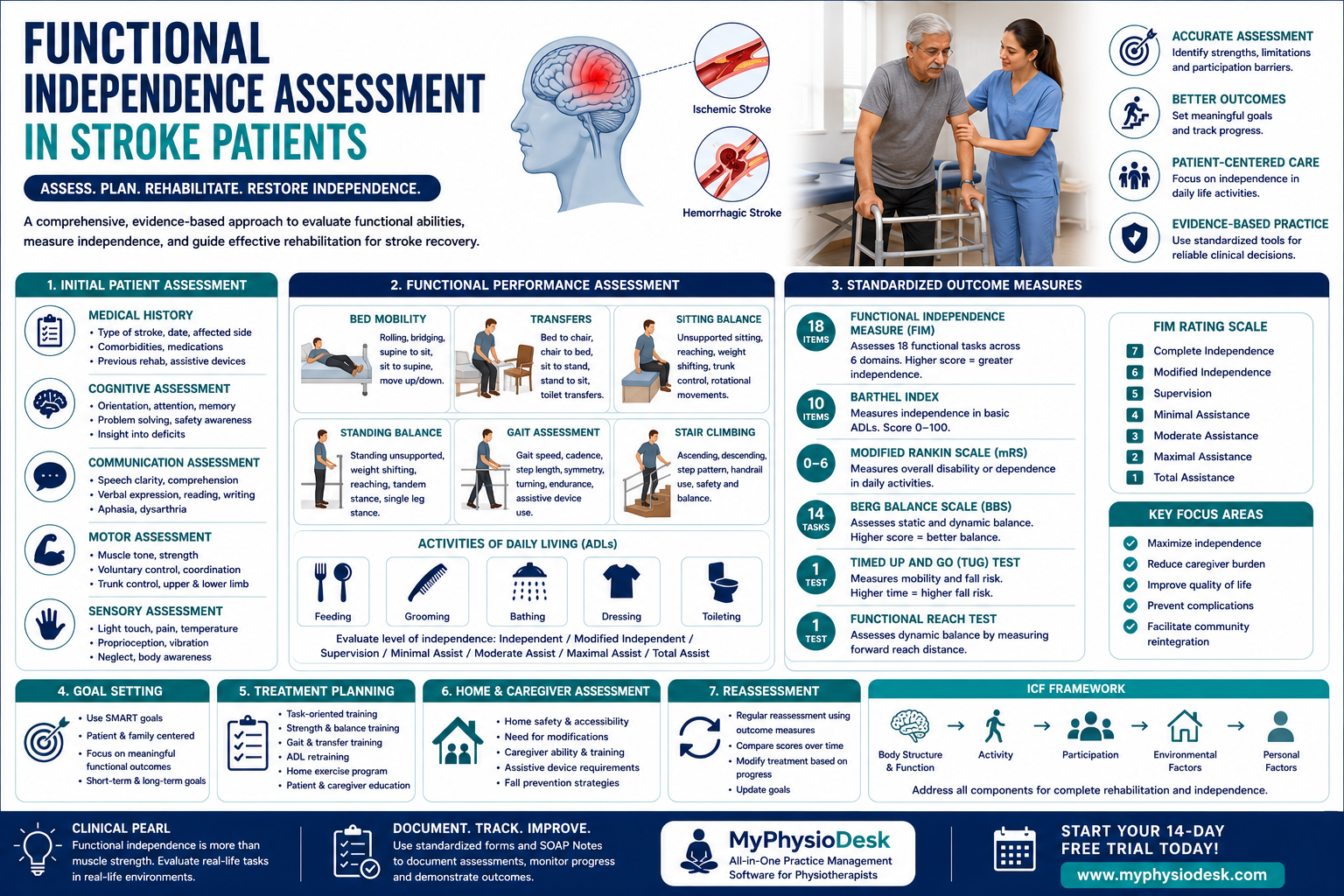
Modern neurological rehabilitation is based on the World Health Organization's International Classification of Functioning, Disability and Health (ICF) model. Rather than focusing solely on physical impairments, the ICF framework considers how health conditions influence an individual's ability to participate in daily life.
The ICF model evaluates:
- Body Structure and Function
- Activity Limitations
- Participation Restrictions
- Environmental Factors
- Personal Factors
Using the ICF model encourages physiotherapists to adopt a patient-centered approach that addresses functional recovery rather than isolated impairments.
Step 1: Medical History
Before beginning the physical examination, review the patient's medical records and obtain a detailed history from the patient and caregiver.
Collect information regarding:
- Type of Stroke (Ischemic or Hemorrhagic)
- Date of Stroke
- Affected Side
- Previous Stroke Episodes
- Medical Comorbidities
- Hypertension
- Diabetes Mellitus
- Heart Disease
- Current Medications
- Previous Rehabilitation
- Assistive Devices Used
- Living Environment
- Occupation Before Stroke
- Social Support
Step 2: Patient Interview
Interview both the patient and caregiver to understand the patient's functional limitations and rehabilitation priorities.
Important questions include:
- What activities are most difficult?
- Can you walk independently?
- Can you transfer without assistance?
- Can you dress yourself?
- Can you eat independently?
- Can you bathe safely?
- Have you experienced any falls?
- What are your rehabilitation goals?
Listening to the patient's concerns often reveals challenges that may not be apparent during the physical examination.
Step 3: Cognitive Assessment
Cognitive impairment significantly influences functional independence and rehabilitation outcomes. Patients with reduced attention, memory deficits, or poor problem-solving skills may require additional supervision even if motor recovery is good.
Evaluate:
- Level of Consciousness
- Orientation to Person, Place, and Time
- Attention and Concentration
- Short-Term Memory
- Long-Term Memory
- Problem Solving Ability
- Safety Awareness
- Insight into Deficits
- Ability to Follow Commands
Patients with impaired cognition often require modified rehabilitation strategies and caregiver education.
Step 4: Communication Assessment
Effective communication is essential for patient participation during rehabilitation. Stroke may affect speech, language comprehension, and expression.
Assess:
- Speech Clarity
- Language Comprehension
- Verbal Expression
- Reading Ability
- Writing Ability
- Ability to Follow Multi-Step Instructions
- Presence of Aphasia
- Presence of Dysarthria
Communication impairments should be documented because they directly influence functional independence and discharge planning.
Step 5: Motor Assessment
Motor impairment is one of the primary contributors to reduced independence following stroke. Evaluate movement quality before assessing functional activities.
Assess:
- Muscle Tone
- Spasticity
- Flaccidity
- Voluntary Movement
- Selective Motor Control
- Coordination
- Trunk Control
- Upper Limb Function
- Lower Limb Function
Document asymmetry, abnormal movement patterns, synergistic movements, and compensatory strategies.
Step 6: Sensory Assessment
Sensory deficits frequently reduce balance, coordination, and independence in daily activities. A thorough sensory examination should always accompany motor assessment.
Evaluate:
- Light Touch
- Pain Sensation
- Temperature
- Proprioception
- Vibration Sense
- Stereognosis
- Neglect
- Body Awareness
Impaired sensation may significantly increase fall risk and reduce the patient's ability to perform functional tasks safely.
Clinical Tip
Functional independence should never be judged solely by muscle strength. A patient may demonstrate near-normal strength but remain dependent because of poor balance, impaired coordination, cognitive deficits, neglect, or reduced safety awareness. Always assess the patient performing real-life functional activities before determining their level of independence.
Step 7: Bed Mobility Assessment
Bed mobility is often the first functional activity assessed after a stroke. A patient's ability to move independently in bed directly affects transfers, pressure relief, and overall independence.
Assess the patient's ability to:
- Roll to the affected side
- Roll to the unaffected side
- Bridge
- Move up in bed
- Move down in bed
- Transition from supine to sitting
- Transition from sitting to supine
Observe:
- Amount of assistance required
- Movement quality
- Use of compensatory strategies
- Trunk control
- Upper limb participation
- Lower limb participation
Step 8: Transfer Assessment
Safe transfer ability is one of the strongest indicators of functional independence and discharge readiness.
Assess:
- Bed to Chair Transfer
- Chair to Bed Transfer
- Sit to Stand
- Stand to Sit
- Wheelchair Transfer
- Toilet Transfer
- Car Transfer (if appropriate)
Observe:
- Weight shifting
- Balance
- Safety awareness
- Use of affected limb
- Need for verbal cueing
- Level of assistance
Step 9: Sitting Balance Assessment
Sitting balance is essential before progressing to standing and walking activities.
Assess the patient's ability to:
- Sit unsupported
- Maintain upright posture
- Reach forward
- Reach sideways
- Rotate the trunk
- Weight shift
Observe:
- Postural alignment
- Protective reactions
- Trunk stability
- Loss of balance
- Need for upper limb support
Step 10: Standing Balance Assessment
Standing balance is critical for independent mobility and fall prevention.
Evaluate:
- Standing unsupported
- Feet together standing
- Tandem standing
- Single-leg standing (when appropriate)
- Weight shifting
- Reaching activities
Document:
- Postural sway
- Balance confidence
- Need for assistance
- Protective reactions
- Risk of falling
Step 11: Walking (Gait) Assessment
Walking ability is one of the primary rehabilitation goals following stroke. Gait assessment should include both quality and functional performance.
Assess:
- Walking Speed
- Cadence
- Step Length
- Stride Length
- Toe Clearance
- Heel Strike
- Symmetry
- Turning Ability
- Endurance
- Use of Assistive Devices
Observe for:
- Circumduction
- Hip Hiking
- Foot Drop
- Knee Hyperextension
- Trendelenburg Gait
- Reduced Arm Swing
Step 12: Stair Climbing Assessment
Stair negotiation requires strength, balance, coordination, and confidence. It is an important functional activity before discharge.
Assess:
- Ascending Stairs
- Descending Stairs
- Handrail Use
- Step Pattern
- Balance During Stair Negotiation
- Safety Awareness
Step 13: Activities of Daily Living (ADLs)
Activities of Daily Living (ADLs) provide a practical measure of a patient's independence in everyday life.
Evaluate the patient's ability to perform:
- Feeding
- Grooming
- Bathing
- Dressing
- Toileting
- Bladder Management
- Bowel Management
- Personal Hygiene
- Functional Mobility
Document whether each activity is performed independently, with supervision, partial assistance, or total assistance.
Functional Independence Measure (FIM)
The Functional Independence Measure (FIM) is one of the most widely used outcome measures in stroke rehabilitation. It evaluates both physical and cognitive independence across 18 functional tasks.
The FIM includes:
- Self-Care
- Sphincter Control
- Transfers
- Locomotion
- Communication
- Social Cognition
Higher scores indicate greater independence and lower caregiver burden.
Barthel Index
The Barthel Index measures a patient's ability to perform basic Activities of Daily Living independently.
It evaluates:
- Feeding
- Bathing
- Grooming
- Dressing
- Bowel Control
- Bladder Control
- Toilet Use
- Transfers
- Mobility
- Stair Climbing
The Barthel Index is simple, reliable, and widely used in stroke rehabilitation settings.
Modified Rankin Scale (mRS)
The Modified Rankin Scale is commonly used to assess the overall level of disability following stroke.
Scores range from:
- 0 = No Symptoms
- 1 = No Significant Disability
- 2 = Slight Disability
- 3 = Moderate Disability
- 4 = Moderately Severe Disability
- 5 = Severe Disability
- 6 = Death
The mRS is widely used in stroke research and clinical outcome reporting.
Berg Balance Scale (BBS)
The Berg Balance Scale objectively measures static and dynamic balance in stroke patients.
It includes tasks such as:
- Sit to Stand
- Standing Unsupported
- Standing with Eyes Closed
- Turning 360°
- Picking an Object from the Floor
- Standing on One Leg
Lower scores indicate a higher risk of falls and reduced functional independence.
Timed Up and Go (TUG) Test
The Timed Up and Go Test evaluates functional mobility and fall risk.
The patient is asked to:
- Stand from a chair.
- Walk 3 meters.
- Turn around.
- Return to the chair.
- Sit down safely.
Longer completion times generally indicate reduced mobility and an increased risk of falls.
Functional Reach Test
The Functional Reach Test assesses dynamic balance by measuring the maximum distance a patient can reach forward without losing balance.
Observe:
- Reach Distance
- Weight Shifting Ability
- Compensatory Movements
- Fear of Falling
Reduced reach distance is associated with impaired balance and increased fall risk following stroke.
Clinical Pearl
Never rely on a single outcome measure when evaluating functional independence after stroke. Combining mobility assessments, ADL evaluation, balance testing, standardized outcome measures, and clinical observation provides a far more accurate picture of the patient's functional abilities and rehabilitation needs.
Step 14: Goal Setting
Once the assessment has been completed, physiotherapists should establish realistic, measurable, and patient-centered rehabilitation goals. Goals should address not only impairments but also improvements in activity and participation, enabling patients to regain independence in meaningful daily tasks.
Use the SMART principle when setting rehabilitation goals:
- Specific – Clearly define the objective.
- Measurable – Use standardized outcome measures.
- Achievable – Match the patient's current abilities.
- Relevant – Focus on functional independence.
- Time-Bound – Establish realistic review timelines.
Examples of Short-Term Goals
- Transfer independently from bed to chair within two weeks.
- Maintain unsupported sitting for 15 minutes.
- Walk 25 meters safely using a walker.
- Improve Barthel Index score by 10 points.
Examples of Long-Term Goals
- Independent community ambulation.
- Perform all basic ADLs without assistance.
- Return to work or previous social activities.
- Reduce caregiver dependency.
Step 15: Clinical Decision Making
Clinical decision making involves combining subjective information, neurological examination findings, functional assessments, standardized outcome measures, and patient goals to determine the most appropriate rehabilitation strategy.
Clinical reasoning should consider:
- Severity of neurological impairment.
- Functional limitations.
- Balance deficits.
- Fall risk.
- Cognitive ability.
- Communication status.
- Home environment.
- Family support.
- Patient motivation.
Treatment decisions should always prioritize activities that will have the greatest impact on the patient's independence and quality of life.
Step 16: Develop an Individualized Treatment Plan
Every rehabilitation program should be tailored to the patient's impairments, functional goals, and stage of recovery.
The treatment plan may include:
- Bed Mobility Training
- Transfer Training
- Balance Training
- Gait Training
- Task-Oriented Functional Training
- Strengthening Exercises
- Trunk Control Exercises
- Upper Limb Rehabilitation
- Constraint-Induced Movement Therapy (when appropriate)
- Functional Electrical Stimulation (FES)
- Endurance Training
- Home Exercise Program
- Patient Education
- Caregiver Training
Treatment intensity should progress gradually while considering fatigue, cardiovascular endurance, and patient safety.
Step 17: Home Environment Assessment
Successful rehabilitation extends beyond the clinic. Assessing the patient's home environment helps identify barriers that may limit functional independence after discharge.
Evaluate:
- Entrance Accessibility
- Number of Stairs
- Bathroom Safety
- Bedroom Accessibility
- Walking Space
- Floor Hazards
- Lighting
- Need for Grab Bars
- Wheelchair Accessibility
- Availability of Assistive Devices
Recommendations for home modifications can significantly reduce fall risk and improve long-term independence.
Step 18: Caregiver Assessment
Family members and caregivers play an essential role in stroke rehabilitation. Assess their ability to provide safe assistance while promoting patient independence.
Discuss:
- Transfer Assistance
- Safe Walking Support
- Home Exercise Supervision
- Fall Prevention Strategies
- Medication Compliance
- Emergency Response Plan
- Patient Motivation
Educating caregivers improves patient safety, reduces complications, and supports successful rehabilitation at home.
Reassessment
Stroke rehabilitation is a dynamic process. Regular reassessment ensures that treatment remains effective and appropriate as the patient progresses.
Reassess regularly:
- Functional Independence Measure (FIM)
- Barthel Index
- Modified Rankin Scale
- Berg Balance Scale
- Timed Up and Go Test
- Functional Reach Test
- Walking Speed
- Transfer Ability
- ADL Performance
- Patient Goals
Comparing outcome measure scores across multiple sessions allows physiotherapists to objectively demonstrate rehabilitation progress.
Common Assessment Mistakes
- Assessing only muscle strength while ignoring functional performance.
- Failing to evaluate Activities of Daily Living.
- Ignoring cognitive impairment.
- Not screening for fall risk.
- Skipping caregiver assessment.
- Using only one standardized outcome measure.
- Poor clinical documentation.
- Not reassessing patient progress regularly.
- Setting unrealistic rehabilitation goals.
- Ignoring the patient's personal priorities.
Comprehensive Functional Independence Assessment Checklist
- ✅ Medical History
- ✅ Patient Interview
- ✅ Cognitive Assessment
- ✅ Communication Assessment
- ✅ Motor Assessment
- ✅ Sensory Assessment
- ✅ Bed Mobility
- ✅ Transfers
- ✅ Sitting Balance
- ✅ Standing Balance
- ✅ Gait Assessment
- ✅ Stair Assessment
- ✅ Activities of Daily Living (ADLs)
- ✅ Functional Independence Measure (FIM)
- ✅ Barthel Index
- ✅ Modified Rankin Scale
- ✅ Berg Balance Scale
- ✅ Timed Up and Go Test
- ✅ Functional Reach Test
- ✅ Goal Setting
- ✅ Treatment Planning
- ✅ Home Assessment
- ✅ Caregiver Education
- ✅ Follow-up Plan
Evidence-Based Practice
Current stroke rehabilitation guidelines recommend combining standardized outcome measures with clinical observation and patient-centered functional assessment. Tools such as the Functional Independence Measure (FIM), Barthel Index, Berg Balance Scale, and Timed Up and Go Test provide reliable, objective data that improve treatment planning and allow clinicians to monitor rehabilitation outcomes over time.
Evidence also supports task-specific training, repetitive functional practice, early mobilization when medically appropriate, and multidisciplinary rehabilitation as key factors in improving functional independence after stroke.
Final Thoughts
Restoring functional independence is the primary objective of stroke rehabilitation. A comprehensive assessment that evaluates mobility, balance, cognition, communication, Activities of Daily Living, and standardized outcome measures enables physiotherapists to identify meaningful rehabilitation goals and deliver individualized, evidence-based care.
Consistent documentation throughout the rehabilitation journey is equally important. Recording assessment findings, outcome measure scores, patient goals, and progress helps clinicians make informed decisions while ensuring continuity of care across multiple treatment sessions.
MyPhysioDesk simplifies neurological rehabilitation by providing built-in Digital Assessment Forms, structured SOAP Notes, Outcome Measure Recording, Goal Tracking, Patient Progress Monitoring, Clinical Attachments, and secure Cloud-Based Patient Records. These features help physiotherapists document every assessment professionally, compare rehabilitation outcomes over time, and spend more time delivering high-quality patient care instead of managing paperwork.
Transform Your Stroke Rehabilitation Workflow with MyPhysioDesk
Whether you're treating patients in an outpatient clinic, rehabilitation center, or home care setting, MyPhysioDesk helps you organize neurological assessments, create structured SOAP Notes, record standardized outcome measures, monitor functional recovery, and maintain complete digital patient records—all from one secure cloud-based platform.
Start your 14-Day FREE Trial today.
🌐 https://myphysiodesk.com
Back to blog